

I have been enjoying Ken Burns’ American Revolution. From what I’ve seen so far, it relies on solid scholarship. What follows in this and subsequent posts will be neither a review nor an attempt at major criticism. Rather, I’m just going to provide a running commentary on things that I noticed in each episode—things that made me think, or pause, or do this:

Some of my comments will be nitpicks, since I study this period and I inevitably come across small points where I might have made a different choice. But that shouldn’t take away from my broader admiration for the documentary: it’s very good!
Framing the War
Episode one does three different things. First, it provides the stakes—why we should care about the war. Second, it explains the political conflict that brought about the Revolution, often from non-traditional perspectives. Third, it tells the story of the bloodshed of 1775.
Early on, the narration explains that the American Revolution was actually three overlapping wars:
It was fought in hundreds of places, from the forests of Quebec to the backcountry of Georgia and the Carolinas; from the rough seas off England, France and in the Caribbean, to the towns and orchards of Indian Country.
In other words, it was a global war.
It was also an insurgency, a rebellion against an empire:
The war grew out of a multitude of grievances lodged against the British Parliament by British subjects living an ocean away in 13 otherwise disunited colonies.
Finally, it was a civil war:
It was also a savage civil war that pitted brother against brother, neighbor against neighbor, American against American, killing tens of thousands of them.
I am in violent agreement with all three descriptions of the war. I use a similar framing when I teach the American Revolution.
What I found curious is that in the listing of the war’s geographic scope, the narration ignores India. This is low-hanging fruit—what could be more impressive than showing that a war that started at Lexington and Concord reached all the way to the other side of the world! Indeed in the description of the Seven Years’ War (1756–1763) that comes just a few minutes later, the historian grabs that fruit: “[The Seven Years’ War] is fought in the Caribbean, it’s fought in Africa, it’s fought in India, it’s fought in the Philippines.”
That’s true, but you could say almost the exact same thing about the American Revolution.
From 1780 to 1783, the British and French fought a bitter naval war across the Indian Ocean. A small British squadron under Sir Edward Hughes was on station providing effective support for the East India Company’s war against the Nabob of Mysore, Hyder Ali. Mysore’s French allies showed up at the end of 1781 with a squadron eventually led by Pierre André de Suffren, a naval officer’s naval officer. Suffren was “slovenly and foul-mouthed,” bold, aggressive, sarcastic, and brilliant. Hughes was exactly the opposite—reserved, genteel, safe.1
The two fleets fought five times over the course of 1782 and 1783, each time with no decisive result. Suffren’s squadron was more powerful; Hughes’ was more disciplined. The war ended before either side could achieve sufficient command of the Indian Ocean to achieve their strategic goals, but ever since, naval officers have studied the unusual campaign closely. Fleet Admiral Ernest J. King, the head of the U.S. Navy in the Second World War, argued Suffren was one of the five greatest admirals in world history.2
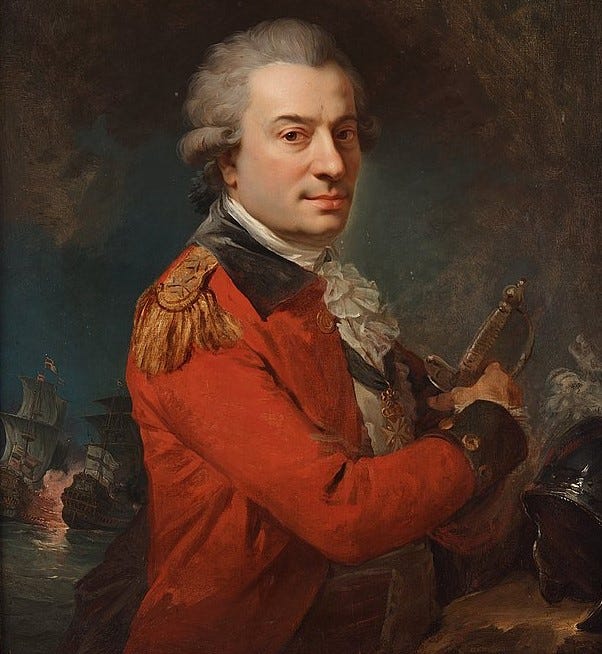
The point is, Suffren vs Hughes was a large campaign involving tens of thousands of soldiers and sailors in a global war that had started in a Boston suburb. While the naval actions in the Indian Ocean ended without a decisive result, that in itself was important because it allowed the East India Company to continue its steady march to control most of the subcontinent. In naval history, Suffren’s aggression and harsh treatment of his subordinates served as a model for many subsequent naval officers who equated aggression, shouting, and a foul mouth with effectiveness.
But neither of those legacies has anything to do with American independence. While the omission of India from the documentary’s narration is a minor point, it reinforced my suspicion that its focus was going to remain on American independence über alles. It’s not obvious to an American audience why they should care about Suffren, so they left him out (for now, at least—let’s circle back in a few episodes). Given that framing, I’ll be interested to see how the documentary handles the many other aspects of the global war that are largely unrelated to American independence—not just India but also the League of Armed Neutrality and the fighting in the West Indies and more.
A World before Police
I had some preliminary concerns with the episode’s treatment of the Boston Massacre. The narrator and some of the historians treat London’s decision to send the army to the unruly colonies as a shocking development in peacetime: “An army during wartime makes sense,” says one historian. “Of course, you need that. But an army during peacetime is a standing army. And if you have an army during peacetime, the thinking is that its only use is to turn on poor, innocent subjects.”
As I’ve discussed on this blog, in fact, there weren’t any other options.

Here’s what I said in that post:
For mobs more serious than drunken rioting, the plan in the eighteenth century almost always involved sending the army. When soldiers arrived at the scene of a riot, often that was enough—even drunken rioters often said, oh crap, the army’s here, this is serious, time to go home. But if showing up wasn’t enough, things got tricky. Soldiers could march around and look imposing, or they could try to guard something.
If that still wasn’t enough, things usually got out of control. That’s where the massacres came from. Soldiers are not trained for non-lethal crowd control. That was as true in the eighteenth century as it is now. After parading and guarding something, soldiers often ended up firing over the heads of the crowd or advancing with bayonets. At the Boston Massacre in 1770, soldiers were guarding the Custom House when they got sick of getting pelted with bricks.
I’m not discounting how Bostonians felt about the arrival of the British army in the late 1760s; I’m just pointing out that it was highly ordinary for London to order army regiments into the colonies to keep them in line.
I was relieved, therefore, that Christopher Brown made a similar point later in the episode: “The British Government sees this as a police action, that if they can punish Boston and shut down Massachusetts, contain the rebellion, that the other colonies would get the message and that order could be restored with some grumbling.” Well there’s no other way to police the colonies than to send the army.
Those were my two thoughts about episode one; next week, I’ll do the same for episode two.
N.A.M. Rodger, The Command of the Ocean: A Naval History of Britain, 1649–1815 (Norton, 2004), 356–57.
Ernest J. King and Walter Muir Whitehill, Fleet Admiral King: A Naval Record (Norton, 1952), 639. The other four were Nelson, St. Vincent, Farragut, and Van Tromp.
On Suffren, as Napoleon said, “Had he been alive at the time, he would have been my Nelson.”
That said, as an American raised in Toronto, where I grew up with the sense that we (collectively) were inheritors of the good government bequeathed us by the United Empire Loyalists, whom American call Tories, I am curious to see how the documentary deals with them.
I enjoyed the episode, but I was surprised it gave almost no attention to the Bernard Bailyn notion that the colonists were listening to extreme if not paranoid British political philosophers when they started advancing their anti-imperial arguments.