

I read everything David Ignatius writes. He is expert on American foreign policy, especially the Middle East, our defense obligations and NATO, and in particular the CIA. In the last three years he has led his readers through the quagmire of politics, drones, and evolving strategies of the war in Ukraine. He is also a spy novelist, perhaps most famous for Body of Lies and Agents of Innocence, but most recently for Phantom Orbit and The Quantum Spy. I call your attention, however, to a recent column in The Washington Post. He sets aside current affairs to write a tribute to Starling Lawrence, his editor beginning with his seventh novel, Body of Lies.
Having suffered through some disdainful editors, I grimaced, barked out loud, and sometimes denied my tears as Ignatius catalogues Lawrence’s fierce attacks on overused language. For example, Ignatius writes, “[w]hen I wrote: ‘A cloud seemed to pass over her face, darkening her features,’ Lawrence responded: ‘Something I have often heard & seldom believe.’” But another example is worth citing at length because of our collective interest in and love of Patrick O’Brian.
Ignatius writes, “Finally … Lawrence offered me a general admonition about writing: ‘Beware of the Obvious!’ he wrote in large letters. … Sometimes cutting beats revising … Try rewriting with the goal of leaving out everything you possibly can — the Patrick O’Brian technique of narration — and if the reader has to scramble a bit to understand, that’s okay. I once suggested to POB that a glossary in his books would be useful. ‘Oh no,’ he replied. ‘Ignorance of the cross-catharpin [a brace for a ship’s mast] is not necessarily fatal. Explanation of it surely is.’”
Not only did Lawrence edit O’Brian, but he was also the editor responsible for transforming O’Brian from a well-regarded British novelist with a modest income (in itself quite an accomplishment) to a best-selling writer worldwide. Lawrence met a cousin for a drink, and the cousin asked him how he could call himself a publisher if he wasn’t publishing Patrick O’Brian. And so he read Reverse of the Medal, the eleventh novel in the series (1986), and agreed—it was the pillory scene that convinced him.
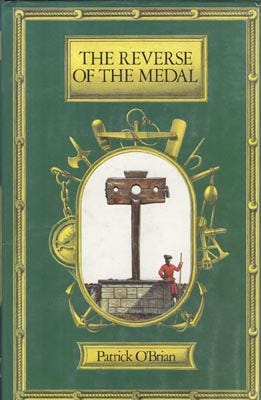
Lawrence still had to overcome several obstacles to convince Norton to refit the O’Brian ship, however. The novels had not sold well to an American audience the first time. Lawrence argued they should be republished, starting from the beginning. He eventually prevailed, the books were republished in paper, and were soon celebrated again by the likes of John Bayley, the Oxford Don who wrote, “These are emphatically not adventure stories … not mechanical marine tales that spring from the wake of C.S. Forester.” And along the way, though Ignatius emphasizes that Lawrence was not fatherly or priestly, he had to console O’Brian, who was devastated by a pseudonymous reviewer in The New York Times. That reviewer, hiding behind the name Callendar, at best skimmed the book, got some facts wrong, and sneeringly wrote O’Brian didn’t have “Forester’s flair.” As much as I admire C.S. Forester, O’Brian’s language separates his books from simply being marine tales.
Starling Lawrence discovered many writers. Some books we remember include The Day of the Condor, Helter Skelter, and The Rotation Diet. He edited Michael Lewis in his Liar’s Poker, Sebastain Junger in The Perfect Storm, and, as we note, David Ignatius. But in the case of Patrick O’Brian, I for one was delighted to learn that Lawrence had no nautical history and was unsuccessful as a youth in sailing. He said he loved O’Brian’s language, not ships. I propose there are three kinds of readers of O’Brian: those readers content not to know what the hell a cross-catharpin was, but loved the drama of the sea yarn and that marvelous language; those sailors who could explain a cross-catharpin, I joke, with an unavoidable sense of naval righteousness, or one-upmanship; and those who could not let a word pass without knowing what it means, still searching in vain through the Oxford English Dictionary.
But let us finish with Lawrence’s summation of Patrick O’Brian’s technique: “Try rewriting with the goal of leaving out everything you possibly can.” In a previous post I have already complained about the length O’Brian goes to when he describes Jack overseeing the outfitting of his command. Clueless, I didn’t know half of what was happening, and I still think O’Brian might make his readers work too hard. But what he never does is explain too much, which gives his stories a sense of being true to experience. And for a novelist, that is all.
Having grown up with Hornblower and Forester, O'Brian was clearly a step or two better and it's interesting to hear at least in part why. I'm about to embark on a reading project focused on Age of Sail novels placed as best I can in chronological order, so I'll be putting down an O'Brian and picking up a Pope, to be followed by a Kent and then maybe a Forester reread. It should be an interesting project!
The funny thing is I like editing colleagues’ work, if I can get into their mindset and help make clearer what they write. My assistance is rooted in every bit of advice I got from good teachers, with a painfully long time to incorporate their corrections into my own writing.