

Last week I had the privilege of speaking at the Newport Historical Society on the occasion of the 250th anniversary of the U.S. Navy. The actual anniversary is in fact today, October 13, 2025. Happy Birthday, Navy! Here’s a lightly edited version of what I said in my lecture, which was not recorded:
I’ll bet you didn’t know that historians have a superpower. I’ll also bet you didn’t know that whenever we use that superpower, we run the risk of blowing ourselves up. Our superpower is that we know the ending. In a sense, knowing the ending of a story is like being able to predict the future. Because we know the ending, we can identify parts of a story that matter. We can make connections that those who were living at the time couldn’t.
Here in the present, of course, we confront this problem every day. We all wish we could know the future—it would make life significantly easier. But we don’t. All we know is the present and the past, both imperfectly, and we definitely don’t know how our own stories will end. So when historians try to tell a story about the past, they are doing so with knowledge that those in the past did not have. That’s a powerful tool. A superpower, if you’ll allow it.
At the same time, it’s an incredibly dangerous tool to use. Because we know the ending, historians run the risk of telling those in the past that they should have understood something that they could not possibly have understood. Because we know the ending, ironically we have to forget that ending in order to recreate the world as it looked to those in it.
Alright, sorry, this is a terrible introduction. This sounds too much like a graduate seminar. Shut up, Wilson, I can hear you saying. I came here to hear about John Paul Jones and instead you’re scratching your chin about how time works.
But the reason I started with that irony, the irony of knowing the ending, is that it helps us put an event like October 13, 1775, in its proper context.
What was the event of October 13, 1775? On that day, the Second Continental Congress authorized the purchase of two armed vessels and created a committee to oversee naval costs. We use that day to mark the founding of the Continental Navy, and that’s the date that the U.S. Navy celebrates as its birthday. Therefore, as I’m sure you’re all aware, Monday, October 13, 2025, marks the 250th birthday of the U.S. Navy. Happy Birthday, Navy.
I am employed by the U.S. Navy, and therefore I also have to tell you that the views and opinions I express today are not necessarily those of the Navy or the U.S. Government.
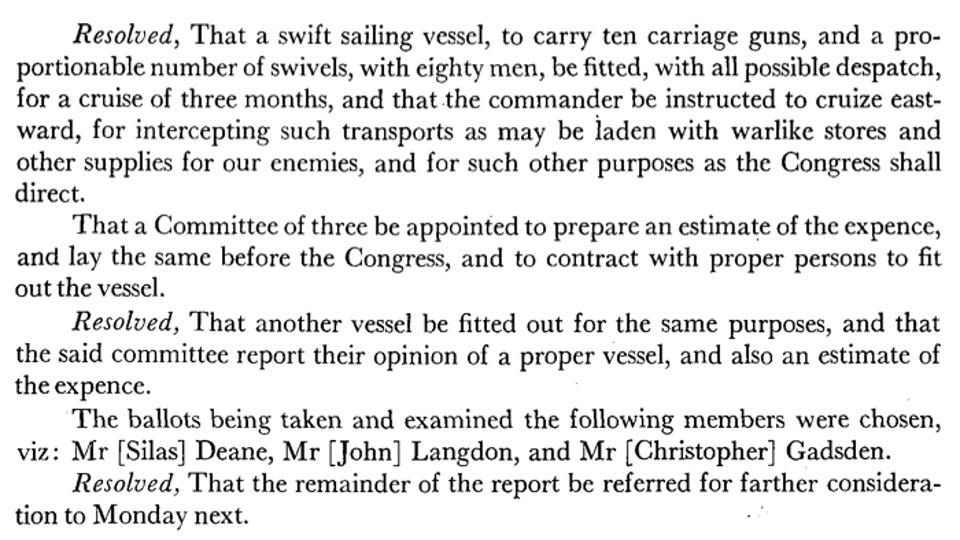
Back to October 13, 1775. We now know that two armed vessels and a committee to oversee naval costs eventually led to the globe-spanning superpower navy of the twentieth and twenty-first centuries. But did Congress know that in 1775? Did the first men to serve on those two armed vessels? Did the British forces they fought? Did the British ministers in London? Of course not. Nobody then knew the significance of that date. And that’s the story that I want to tell you today. That’s the world I want to recreate—the world of uncertainty, of an unknown future.
How do we make decisions amid uncertainty? I don’t mean, how do we make good decisions amid uncertainty—there’s a whole business school apparatus dedicated to answering that question. I mean, how did Congress decide to found a navy? Well, as I said, nobody in October 1775 could possibly know with any kind of certainty that American independence, and specifically a united group of thirteen states, led by one federal government, was in their immediate future, nor exactly how the Continental Navy would help bring about that future. Instead, they formed their ideas as all of us do, by referencing a known past and an imagined future.
Let’s start with the known past. Colonial Americans understood that they lived in a maritime world. Not only did their colonies hug the coast, but water was the fastest mode of transportation over medium and long distances that man had ever known. The colonies depended on water transportation for food, goods, and livelihoods. Coastal trade linked the colonies with each other and with the Atlantic world—the triangle trade of enslaved people, rum, and manufactured goods, for example, provided the engine for Newport’s economy. The sea was where wealth came from.
Moreover, water was also what connected the colonies with the hinterlands. The great rivers—Connecticut, Hudson, Delaware—and the great bays—Narragansett, Chesapeake—were the colonies’ arteries. They formed natural barriers to overland travel but they also carried goods and people rapidly from port cities to inland settlements.
Since the colonists lived in a maritime world, it was logical that as relations with the mother country deteriorated, they would need to defend their maritime supply lines and move military forces by water. There were lots of different ways they might choose to do that, but the most obvious was to build a navy.
Those in favor of establishing a navy were led by none other than the delegation from Rhode Island. The Rhodies pointed out that not only did they already have a small state navy, but every colony except for Delaware had followed Rhode Island in establishing a naval force over the summer. Pennsylvania and Virginia were building galleys for river defense; Georgia had commissioned a sloop. Now was the time for Congress to form a service parallel to the army that was forming around George Washington, said the delegation from Rhode Island. A Continental Navy would provide for the common defense, not just the defense of individual colonies. Today’s Navy owes a special debt of gratitude to our small state. How appropriate that we are here in Newport tonight celebrating this birthday.
But what did Congress imagine that navy would do? What was its purpose? The great concern in Congress in late 1775 was that the British would cut off all the trade on which the colonies depended. The Continental Navy was needed to defend that trade. The other purpose was to solve a persistent problem that the colonists faced—a shortage of gunpowder. By commissioning some armed vessels, Congress hoped they could intercept British gunpowder shipments to supply the Continental Army.
Fair enough—and simple enough. These were obvious arguments for a navy. But there was an even more obvious argument not to establish a navy. That’s an argument that might seem strange to trot out at this birthday party—almost like parents telling their child that he was a mistake. But the argument had real merit, and we need to take it seriously, even though it lost the battle in Congress. Remember, historians have to be able to recreate the uncertainty of the past and to explore paths not taken. After all, we’re constantly confronted by choices in our own lives and in our own politics; the past was no different.
What, then, was the obvious argument against a navy? First, it was expensive, and the Continental Congress was not exactly swimming in money. Any money spent on a navy was money not spent on Washington’s army. Second, those opposed argued, even if the money was spent perfectly, the navy was destined to be defeated. The British navy was simply too powerful to challenge directly. They said that building a navy to fight the British was like “an infant, taking a mad bull by his horns,” according to John Adams’ notes on the debate.
And if you allow yourself to imagine the world of 1775 without knowing what was about to happen, you can see the argument, right? How could these small thirteen colonies hope to create a navy that would challenge the British? Let’s look at the balance of forces in 1775. Britain had 117 ships of the line and 82 frigates and sloops. Between the various state navies and some purchases that the Continental Navy made in the last months of 1775, we can plausibly say that the Continental Navy had four frigates. That December, they authorized the construction of thirteen frigates and three ships of the line. We can go ahead and add those to the ledger, even though none of the ships of the line ever saw service. That’s still not a fair fight!

Of course, historians can never fully forget the end of the story. You all know that even though the balance of forces here is laughable, and that the colonies on paper stood no chance, in fact, they won! So what I want to do for the rest of the talk is to figure out how the heck that happened. That’s the point of historians having their superpower: because we know that the colonists won, we can try to identify factors that contributed to that victory that might not have been obvious at the time. We still have to keep in mind, though, that we know those factors, but on October 13, 1775, only some of those factors were visible to those who created the Continental Navy. One of those factors that you can see on this chart and that the colonists could see as well was the importance of France and Spain, but remember that the colonies fought by themselves for nearly three years before France joined.
So what are the factors that we can see now that contributed to American independence, especially in the early years of the war? You might expect that the answer to the question of how the two armed vessels and a committee to oversee naval expenses ended up on the winning side against the largest and most powerful navy in the world involves a lot of heroism, of David-against-Goliath kinds of stories. To some degree, that’s true, and I’ll tell you a few stories. But I’m never entirely satisfied by those stories. I think that if you really want to understand how the American Revolution turned out the way it did, you have to spend time looking at the war from the other side of the ocean. After all, if the Continental Navy won, the flip side of that is that the British Navy lost. You can’t understand one without the other. So let’s look at the war from the British perspective to try to figure out how on earth they blew it. A naval version of 28 to 3, for the Pats fans in the audience.
Let’s stay with our key date, October 13, 1775. We know what Congress was doing that day, but what did the war look like from London? Well, the first thing to say is that it was not yet a war. The colonies were in rebellion, and rebellions and wars are related but distinct. Moreover, the British Empire knew how to deal with rebellions. Rebellions usually started as civil disturbances, which is a fancy term for riotous mob. There was an established protocol for dealing with civil disturbances in the eighteenth century: get a bigger mob.
That sounds crazy to us today, but that’s because there were no police forces in the eighteenth century. Instead, whenever a situation got out of control, local officials called magistrates could empower citizens to form a competing mob to defeat the riotous mob. Before they did so, the literally had to read the Riot Act of 1714, which gave mobs an hour to disperse. That’s of course where the expression to read the riot act comes from. I’m mad at you and you better go home in the next hour or else.
“Or else” usually meant calling in nearby troops. For mobs more serious than drunken rioting, the plan in the eighteenth century almost always involved sending the army. When soldiers arrived at the scene of a riot, often that was enough—even drunken rioters often said, oh crap, the army’s here, this is serious, time to go home. But if showing up wasn’t enough, things got tricky. Soldiers could march around and look imposing, or they could try to guard something.
If that still wasn’t enough, things usually got out of control. That’s where the massacres came from. Soldiers are not trained for non-lethal crowd control. That was as true in the eighteenth century as it is now. After parading and guarding something, soldiers often ended up firing over the heads of the crowd or advancing with bayonets. At the Boston Massacre in 1770, soldiers were guarding the Custom House when they got sick of getting pelted with bricks.
The role of the army in suppressing dissent was fundamental to London’s view of the world in 1775. They expected that soldiers would be responsible for dealing with rebellious colonies because that’s what soldiers often did. They had recent experience, too. In 1745, the Jacobite Rebellion in Scotland had managed to get an army together to march on London. If the rebels had had a little more nerve, they might have overthrown the government. In the aftermath of the ’45, the British recognized that they couldn’t risk another army marching south. So they sent the British army into the Highlands to “clear” them, which is a euphemism for occupying them and brutally suppressing dissent. Mostly, it had worked. By 1775, much of Highland Scotland was not only quiescent, but it was also providing lots of soldiers for the army. It was, in a sense, a successful counter-insurgency campaign. It was logical for ministers in 1775 to think sending the army to the colonies would have a similar effect, and many of the men who had served in Scotland were now preparing to deploy to America.
I think we can all see some problems with the “send the army” approach, but we don’t need to use our historian superpower to identify them. I can say that because people at the time said that. Some members of the Cabinet thought it might not be such a good idea to send the army to the colonies. Especially by October 1775, following Lexington and Concord in April and Bunker Hill in June, it was looking more and more like the Americans weren’t an unruly mob but were seriously thinking about fighting back in an organized way.
What was the alternative to sending the army? Well, maybe the navy could help. One idea floated in the Cabinet was to have the navy strangle the rebellion by cutting New England off from the sea—exactly what Congress feared. After all, the colonies depended on maritime trade; a close blockade of the eastern seaboard might hurt the colonies where it mattered most—in their pocketbooks and in their stomachs. Perhaps then the British could rely on the thirteen different American polities to tear themselves apart in recriminations and jealousies and come to a settlement.
But after the events of 1775, neither approach seemed like a sure thing. The army might be able to pacify the Highlands, which are roughly the same size as New Jersey, but colonies stretching from Maine to Georgia presented a different challenge. The navy might be able to strangle colonial trade, but was London sure that would actually bring an end to the rebellion? Wasn’t a blockade, in effect, admitting that the colonies were independent?
To give you a sense of how the British recognized the challenges they were facing, it was the Secretary at War (more or less the civilian head of the army) who suggested a blockade strategy, and the First Lord of the Admiralty (the civilian head of the navy) who suggested sending the army. The point is, both services recognized that winning in America was going to be difficult—let’s make the other service shoulder the burden.
The king chose to send the army. He believed that his coronation oath committed him to keeping the colonies in the Empire, and whatever the logic of a naval strategy, it seemed insufficient to rely on it alone. The blockade strategy still sounded like a good secondary idea, though, so the First Lord of the Admiralty ordered his admirals in North America to do as much blockading as they could. Their first priority, though, was to support the army.
And that brings us back to the size of the British navy. On paper, it sure looked capable of both supporting the army and blockading the coast. But in practice, all it managed to do was support the army (with one exception, which I’ll talk about). Why?
Yes, the British had a powerful navy, both at sea and in the dockyards, but it was mobilizing slowly. The usual pattern for the British was to build ships of the line in peacetime. That’s because ships of the line took so long to build. They were approximately 3,000 tons, carrying 74 or more cannon, and manned by more than 700 men. You had to invest in peacetime to make sure you were ready in wartime with your largest ships. The British were building ships of the line in the years leading up to the war, but what use was a ship of the line against the two armed vessels of the Continental Navy? (An armed vessel, I should explain belatedly, could refer to any boat with a gun on board. The actual act for equipping our first two armed vessels called for ten guns and eighty men per vessel.)
Ships of the line looked impressive, but they weren’t much use if the enemy didn’t have any ships of the line. Even if the Continental Navy built all three of its planned ships of the line (and that was a very big if at the end of 1775), the British wouldn’t need to build any new ships of the line to fight them. They already had more than a hundred!
The point is that the building that the Royal Navy was doing in the 1760s and early 1770s wasn’t really useful for a war in the colonies. Those ships were aimed at the French and the Spanish, and they weren’t involved (yet).
Frigates, on the other hand, were easier to build quickly, so the British tended to wait until hostilities started to build them. A frigate was a do-it-all ship in the age of sail. It usually had between twenty and forty guns, and a crew of 100 to 300, depending on the size. It was useful for cruising against enemy trade, escorting convoys, scouting for enemy fleets and delivering messages. They could also be built in private dockyards, unlike the ships of the line, which usually had to be built in royal dockyards.
So one question we need to ask is, did the British navy think that it was at war in 1775? In 1776? In 1777? Obviously, they were at war in 1778 when the French joined, but let’s leave that period of the war aside for now. Remember we’re trying to recreate the uncertainty of the world in October 1775. Did the British navy really need to mobilize to fight the Continental Navy, which existed almost entirely on paper? Didn’t they already have enough frigates? Again, the ratio here was 82 frigates in the British Navy to at-best and if-everything-went-perfectly 17 in the Continental Navy, and even then only after many months or even years of building and buying. That doesn’t seem like a problem that needs to be addressed.
In any case, mobilizing to fight the Continental Navy might spook the French and the Spanish, encouraging them to join the war sooner, which would make the situation more complicated. So the British chose to deal with the colonists largely with the forces they had already built. And that makes sense, right? They had plenty of frigates and ships of the line to deal with the nearly-nonexistent Continental Navy, surely. That’s the “imagined future” that the First Lord of the Admiralty and other members of the Cabinet had in mind in October 1775.
But believe it or not, the British imagined the wrong future. They tried to fight the rebellion without mobilizing, and it turns out that they didn’t have enough frigates.
To understand why they were short of frigates, we need to understand what the British thought they were doing in late 1775. The king said, send the army, and the Admiralty told its officers: your primary mission is to support the British army. What did it mean to support the British army, and why did that use up so many frigates?
It’s difficult to underestimate the logistical challenge that British military forces faced in this rebellion. They were fighting a rebellion—an insurgency—on the other side of an ocean. That meant that they had to carry their army across the ocean in transports escorted by frigates. Once they arrived in the theater, they had to be landed in a suitable port—first Boston, then New York, then Newport. But that wasn’t all. The navy couldn’t just abandon the army once it had delivered it to New York or Newport because the army couldn’t feed itself without the navy’s help. Armies famously march on their stomachs, and the British quickly discovered the dangers of trying to feed themselves off the land. It exposed them to Patriot raiding parties and tended to make them unpopular with the people who lived on that land. Better, whenever possible, to stay near water. When they were near water, they could always ask the navy for help in resupplying their forces.
Therefore, when the king said, send the army, and when the Cabinet said, the army gets priority, the navy had to expend an enormous amount of energy and ships just keeping the army functional in America. The British consistently overestimated the degree of support they would get from loyalists and underestimated the difficulty of maintaining their armies in the field. The maritime nature of the east coast—the coastal shipping and the rivers—meant that supply by water worked best, but it came at a cost: an enormous expenditure in frigates and sloops and transports.
The navy quickly felt this strategic dilemma. The army was demanding support but building more frigates to support the army might provoke the French and Spanish. The result was that they put all their effort into supporting the army and gave little thought to mission number two, which was to blockade New England.
The British built no new frigates in 1775, just 3 in 1776, and just 4 in 1777, and they purchased two more. One admiral calculated that to do both missions he needed 50 ships in North America with 22 near Boston in August 1775. Instead, just two sloops crossed the ocean between June and September of that year. In 1776, the navy thought it needed 70 ships on station, and by June 1776 there were 57 available … but all but a dozen of them were busy with the army. There were only 3 ships off the port of Boston that summer. When the Howe brothers nearly captured Washington at New York in late 1776, they stripped all the ships from the Delaware and the Chesapeake to help. It almost worked! But as we know it didn’t, and it left the Delaware and Chesapeake completely free from British naval presence.
The one period that they tried a blockade was December 1776 to May 1777, from the occupation of Newport for the next six months. Finally, in the aftermath of the battles around New York, the army was not demanding all of the navy’s attention and the British were able to see what a tight blockade might do. It’s a fascinating natural experiment, a true “what-if”—what if the British had prioritized a maritime strategy, a blockade, instead of a counterinsurgency?
The results of the experiment were and are interesting. Let’s start with the reason we’re here: how did the Continental Navy do when the British navy turned its focus on it? The question here, remember, goes back to the debate in Congress a year earlier. Was a navy necessary for national unity and maritime defense? Or would it be like an infant grabbing a mad bull by the horns?
The answer is pretty clear: like an infant grabbing a mad bull by the horns. The Continental Navy’s combat performance was dismal. When the far superior British Navy was able to ignore the army and concentrate on a naval mission, it was highly effective.
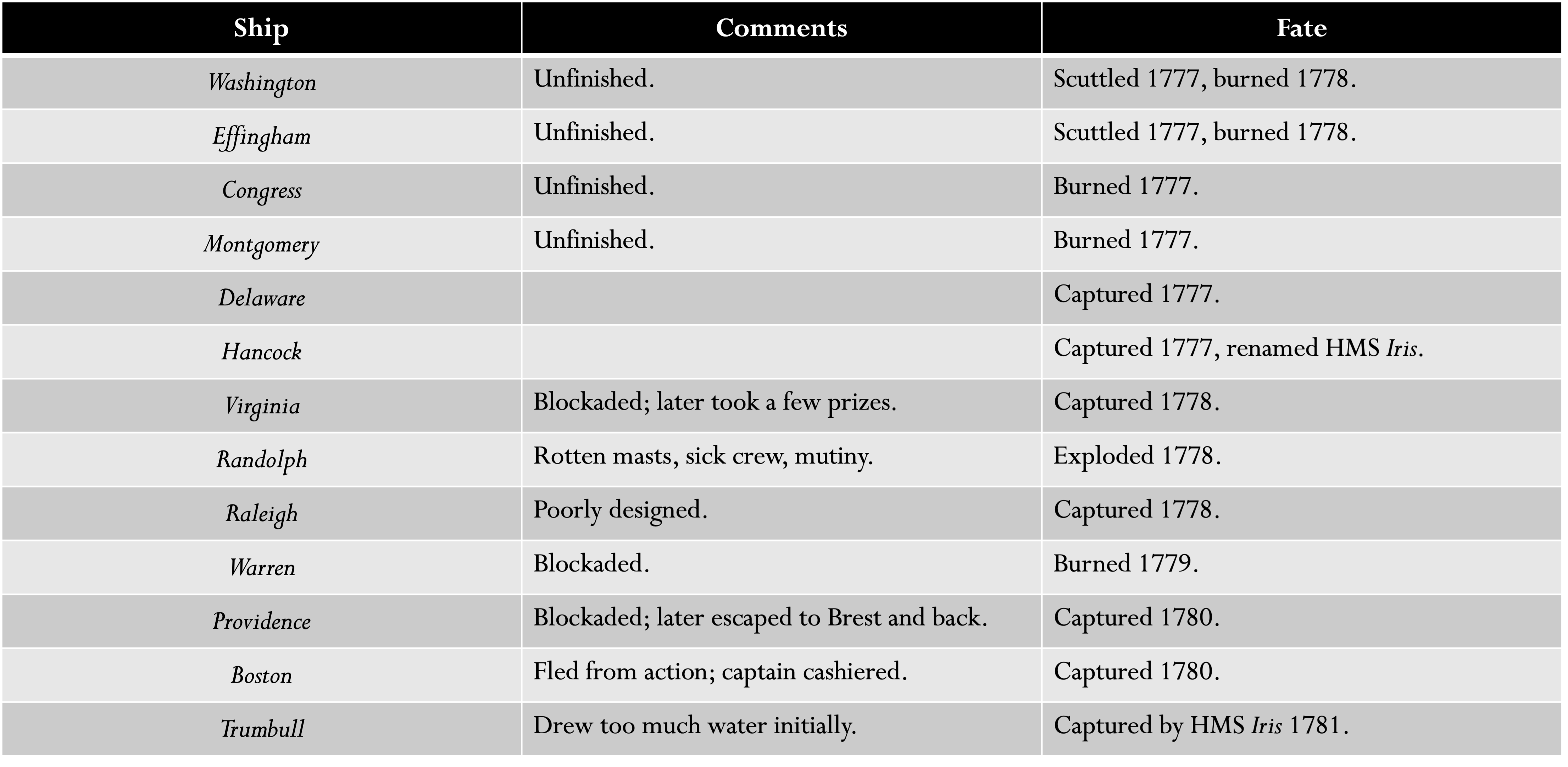
The blockade had political effects as well. Congress panicked. The currency was in trouble. Trade was curtailed. There was no way to finance the war. Congress desperately reached out to the French for help, but they weren’t willing to commit until the Americans could show that they could beat the British army in the field.
So: maybe the blockade would have worked for the British. But for all the reasons already mentioned, they couldn’t sustain it. By the summer of 1777, the army was calling again, this time for the assault on Philadelphia. The blockade thinned out, American commerce took to the seas again, and the crisis passed. I’ll talk later about why the Continental Navy’s record is not the whole story for the blockade, either.
Before I do that, though, let me wrap up this analysis of the British challenges in the early years of the war, before Saratoga in October 1777, that pivotal victory that convinced the French to commit to our cause. It’s not obvious how, exactly, Britain was supposed to win a counter-insurgency campaign across an ocean. Prioritizing the army hampered the effectiveness of the blockade, and the army wasn’t big enough to “occupy” all thirteen colonies—and of course there’s no guarantee that would have worked either. Counter-insurgency is hard. Ask any veteran of the U.S. military. Prioritizing the blockade might have been more effective, but I hope you come away from this lecture with some sense of the kinds of challenges that the British faced, especially during the pivotal first two-and-a-half years of the war.
Are those tensions, between the army and the navy, and between the counter-insurgency versus the blockade strategies, and their knock-on effects, why the British lost the American Revolution? Well, it’s a partial answer. There are many other factors that I don’t have time to talk about today. Certainly, the most important is the transition in 1778 of the war from a counterinsurgency focused on the thirteen colonies to a global war involving the French and then soon the Spanish and Dutch. Suddenly the British had much bigger problems than a rebellion in the colonies: they had a combined French and Spanish fleet sailing up the English Channel with an invading army aboard. Also, our allies provided essential financial and military support that helped us survive till Yorktown and then win at Yorktown in 1781. Again, even that is a partial list.
I just want to show you that the British perspective on the American Revolution makes me, at least, wonder less at how our little David beat their Goliath.
For my last section today, I want to return to the Continental Navy. So far, I’ve covered why Rhode Island thought a navy was a good idea and why the on-paper mismatch between British and Continental power wasn’t quite so simple as you might think. Now, I want to ask, what happened the way that Congress expected it to in 1775, and what turned out differently? Remember my theme here: we know the ending, but they didn’t. So let’s return to the debates about whether to fund a Continental Navy and survey their expectations.
Congress expected the Continental Navy to provide maritime defense. I think I’ve shown you that it didn’t really do that. Mostly, the Continental Navy was bottled up in port, taken, burnt, or sunk. The skeptics who said that it was like an infant taking a mad bull by the horns were right, in the sense that most of the time the baby lost.
Congress also expected that the Continental Navy would not be the entirety of their maritime defense force. They knew that the most common and cheapest form of maritime defense would be privateers. They hoped that the two could operate in concert with each other. In fact, as was so often the case in eighteenth-century maritime conflicts, privateers cannibalized the navy, taking away sailors and supplies that would have been very useful to Continental Navy operations. Let me explain.
Here again we see the maritime character of the thirteen colonies. Small coastal vessels and deep-sea merchant vessels and whalers were common all up and down the eastern seaboard. It was simple enough to convert any of those sorts of vessels into privateers. Step one was to get a letter of marque, which the colonies began authorizing in March 1776. That legitimized the ship as a ship of war that could fight the British and not be accused of piracy. Step two was to get some guns, which entrepreneurs like John Brown in Providence quickly began producing. Step three was to get some men, which was generally easier for privateers than navies. Privateers paid less than the navy, but the crews got a higher share of any prizes captured. Navies, as you know, pay their officers and men salaries, which means they expect their officers and men to follow orders and not just go seek their own fortunes.
Another factor that contributed to the explosion of privateers all along the coast was that British reprisals against coastal shipping or fishing vessels had an annoying tendency (from their perspective) of creating more privateers. After all, if you take away a sailor’s fishing boat, it might make financial sense to turn to privateering. Also, you might be sufficiently pissed off at the British to want to fight back. Think of King George’s line from the musical Hamilton: “When push comes to shove, I will kill your friends and family, to remind you of my love.”
Nearly 2,000 shipowners applied for letters of marque during the war. About 800 ships managed to escape the half-hearted British blockade and get to sea. They captured an estimated 600 British ships. That made a difference, encouraging British shipowners to put pressure on the government to end the war and increasing yet again the navy’s need for frigates.
Notice that I still have not said, “and also the heroic performance of the Continental Navy.” So does that mean that the Continental Navy was a waste of time and money? After all, Congress wanted a maritime defense force and instead got a force that was largely bottled up and in conflict with the colonies’ most effective form of maritime warfare, privateers.
But actually I think there are reasons to celebrate the Continental Navy and its birthday. The primary reasons to do so were either unexpected or considered secondary by those who established it. Let’s use our historian superpower to understand what worked about the Continental Navy, even though those who founded it did not always anticipate the effects of their actions.
I don’t think the founders of the Continental Navy really expected it to attract dubious characters like John Paul Jones. He’s best understood as a mercenary rather than a patriot—he would fight for money if you were willing to pay him. He had also killed a man—he fled from Scotland to Virginia and changed his name (from John Paul to John Paul Jones) before joining the Continental Navy.
The most normal thing that Jones did is sail to France in November 1777 in his ship Ranger. He brought momentous news of the victory at Saratoga. This kind of diplomatic mission on an official Continental Navy vessel is clearly something that the founders of the Continental Navy envisioned, even if the French weren’t in the war when they founded it in 1775.
Like I said, though, that was the last ordinary thing he did. A French merchant gave him a former East Indiaman and named it Bonhomme Richard after Ben Franklin’s Poor Richard’s Almanac. In that ship Jones intercepted a convoy in the North Sea just off the British coast. He took on the escort ship HMS Serapis and was nearly defeated, but he managed to lock Bonhomme Richard and Serapis together. Jones won the ensuing firefight, but then Bonhomme Richard started to sink so they all transferred to Serapis. While all that was happening, the convoy escaped. In all honesty, it was barely a victory. But it was right off the British coast, which gave the Royal Navy a black eye (nobody noticed the convoy escaped). These sorts of actions had an effect far beyond their specific military value. It was the daring nature of Jones’s actions that redounded to the glory of the Continental Navy, not the capture of one British ship. Again—an unexpected benefit of having a navy.
The other reason to celebrate the founding of the Continental Navy was its role in stitching together the colonies and the new republic. Part of that was what Jones did, but there were other aspects as well. At the most basic, literal level, the Continental Navy flew the flag. Maritime states like the United Colonies have navies, and having a navy helped legitimize the American project. When the Dutch colony of St. Eustatius saluted the Grand Union flag on November 16, 1776, it had an outsized impact on perceptions of American independence. When the Continental Navy ship Reprisal showed up in France with Ben Franklin aboard and two prizes in tow, it showed the French that our ambassador was important and that our military power was legitimate. Showing the flag mattered.
Navies require sustained capital investment, more so than armies, even today. You need the power of a strong state to build ships, equip them, man them, arm them, supply them, direct them, repair them, re-build them, pay them, and regulate them. You need uniforms and protocols and a thousand bureaucratic procedures. The individual colonies were like states, but collectively, they were anything but. Remember that it took Congress fifteen years, from about 1774 to 1789, to decide how what we now know as the U.S. Government would look, and the Continental Navy was founded in year two of that process. During the debate about the navy, Rhode Island was arguing, implicitly, that if the colonies were going to take the “Join, or die” print seriously, then they needed to band together, and building a navy was an effective way to do that.
I’m not denying that privateers and ad-hoc forces can be deployed to some effect at sea. But for the project of unifying the states, the Continental Navy was important. The basic requirements of naval power meant that the various colonies had to come together, in Congress, to establish the taxes and bureaucracies and regulations and uniforms and flags that characterized a naval service.
Did the founders of the Continental Navy know all that on October 13, 1775? To some extent, yes: that was why they were debating having a Continental Navy rather than relying on individual colonies to provide naval forces. But in general, it’s easier for us to see this stitching-together role now than it was for those at the time—our historian superpower strikes again. It was not a smooth process, I should say. After the war, the Continental Navy was disbanded in 1785 amid the debate over the national government—this was the era of the Articles of Confederation. The U.S. basically ceased to have a navy for the next nine years. Nevertheless, the experiment of a navy showed leaders like John Adams that federal authority was necessary for some things.
So we should celebrate the founding of the Continental Navy, and we should highlight the specific contribution that Rhode Island made to making the Continental Navy a reality. We should also be aware of the Continental Navy’s strengths and weaknesses, and its loose connection to today’s U.S. Navy (which, whisper it, wasn’t really founded until 1794). What I hope I’ve shown you today is that when the Second Continental Congress established a navy, they correctly imagined some of the things that it did to secure American independence, but not all of the things. Moreover, it’s easier for historians to see that the on-paper matchup between the infant Continental Navy and the mad bull of the Royal Navy obscures many of the challenges that the British faced in winning the war. So Happy Birthday to the U.S. Navy.
Because this was a lecture, I don’t have any footnotes or other citations. If you want to learn more, here are some suggestions for additional reading:
Willis, Sam. The Struggle for Sea Power: A Naval History of the American Revolution. New York: W.W. Norton, 2015.
Hattendorf, John B. “The Formation and Roles of the Continental Navy, 1775–1785,” in Talking about Naval History: A Collection of Essays. Newport: Naval War College Press, 2011.
Baugh, Daniel A. “The Politics of British Naval Failure, 1775–1777,” The American Neptune 52, no. 4 (Fall 1992): 221–46.
Reading "When the Dutch colony of St. Eustatius saluted the Grand Union flag on November 16, 1776, it had an outsized impact on perceptions of American independence." instantly reminded me I need to finish reading Barbara Tuchman's "The First Salute" which I started after reading "The Guns of August" but dropped for some reason. Thanks!
Nicely framed essay—historians do have a privilege in knowing results, which everyone wishes we possess. But that professional knowledge can also let us sometimes see a salient point amidst all the other ideas on display.
On privateering, the Revolutionary War has a (Canadian) song which sums up the practice. The late Stan Rogers did it well in “The Last of Barrett’s Privateers,” set in 1778 and later.