

In September 1972, Patrick O’Brian hand-delivered his 110,000-word manuscript of HMS Surprise to his publisher in London. He used the opportunity to conduct research at the British Library and National Maritime Museum to prepare for the next installment in the series. He also held meetings with his publishers, Collins, on a small book he was working on for their children’s department. HMS Surprise came out in 1973; the children’s book, Men-of-War: Life in Nelson’s Navy, appeared in 1974.1
Given that one of the two themes of this series is the naval history behind O’Brian’s novels, I thought it would be appropriate to review O’Brian’s work of naval history.
I was surprised to learn that it was published as a children’s book. It certainly doesn’t read that way to me, though I gather children’s books have changed dramatically in the last half-century. It’s concise and clear, but not in any way condescending. It’s organized into five chapters: the ships, the guns, the ship’s company, life at sea, and songs. Each chapter tackles its subject seriously and illustrates the author’s deep familiarity with Nelson’s Navy.
That was a fancy way of saying that it’s really good! I try to write concisely and engagingly about Nelson’s Navy, and I cannot imagine doing better than O’Brian did. All of the hallmarks of O’Brian’s writing are there—the witticisms, the insights, and the technical knowledge. The version I read was reissued in 2023 in a small format—it fits in your pocket, almost—and its 73 pages fly by.
At the same time, the book has just turned fifty-one. That’s pretty old for a history book, and it’s not surprising that I found a few places where it needs some updating. In this post and the next, I’ll look at how a combination of O’Brian’s brevity and his reliance on an older generation of scholarship creates unintentional but revealing contradictions.
Eating Rats
Here’s what O’Brian says about ordinary sailors:
Their life was very hard, often dangerous, and always ill-paid. … If their food had been good in the first place and if it had been honestly served out and decently cooked, it would not have been too bad by the standards of the time; but generally this was not the case. Indeed, it was usually so bad that when they could catch them, the men often ate rats, or millers as they were called in their service, because of their dusty coats as they got into the flour and dried peas. They were neatly skinned and cleaned and laid out for sale.2
Rats! Often! Ugh. There’s a clear echo in this passage of the lexicographer Dr. Samuel Johnson’s quip about the navy: “No man will be a sailor who has contrivance enough to get himself into a jail; for being in a ship is being in a jail, with the chance of being drowned ... A man in a jail has more room, better food, and commonly better company.”3
Dr. Johnson seems to have a point. Who would ever serve in the navy if it meant you “often” ate rats? O’Brian follows that premise to its logical conclusion:
[Sailors] were brought together partly by free entry (popular officers like Saumarez or Cochrane could always man their ships with volunteers) and partly by the press gang. Impressment was a rough and ready form of conscription, and the idea was that seamen should be taken from merchant ships or seized on land and compelled to serve in the fleet for as long as their services were required.4
That seems to square the circle nicely: nobody really wanted to join the navy to eat rats unless the captain gave them a chance of getting rich; everybody else was there against their will. No man will be a sailor, Dr. Johnson tells us, and the press gang existed to solve that problem.
Everything O’Brian says here is broadly true. Impressment filled the gap between volunteers and the navy’s needs; popular captains could overcome sailors’ reservations about naval service; conditions on board could be brutal; impressment was an unfair form of conscription, falling as it did on one community (sailors) but not others (landsmen).
So what’s the problem? Well, it has to do with volunteers and with scale. It is hard to imagine how the Royal Navy could grow so large and perform so effectively if it fed its men rats and had to rely so heavily on impressment. Not only was impressment so controversial that it regularly sparked riots and legal challenges, but it was also inefficient. We shouldn’t confuse impressment with the kind of conscription that underpinned the industrial warfare of the twentieth century. There was no central database of British sailors; there were no draft cards.
Nevertheless, the navy grew: its peak strength in the Napoleonic Wars was more than 140,000 men, which was nearly double what it had been in the Seven Years War.
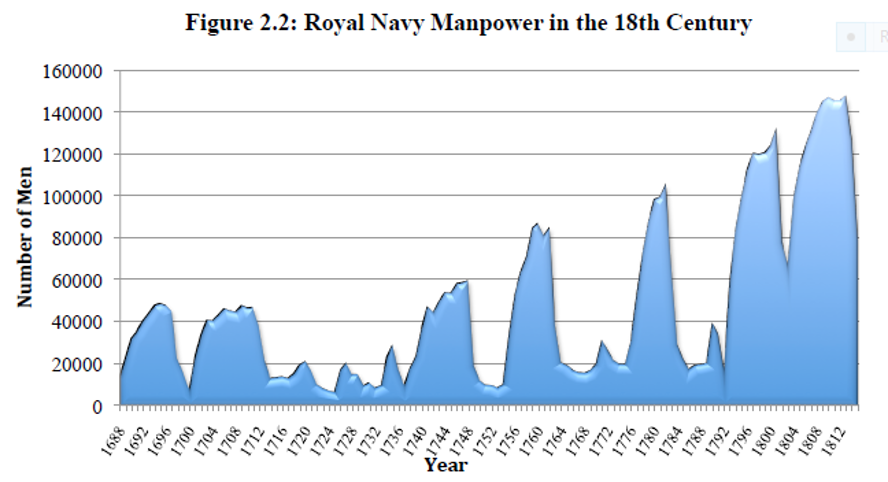
Clearly, many tens of thousands of those men were pressed. The high-end estimates of how many men were pressed in the Napoleonic Wars usually top out around 50% of the deployed force. That’s a lot! But it still leaves some 70,000 men (the other 50%) who apparently volunteered to eat rats.
And it might have even been more than that. My friend and colleague J Dancy looked at heaps of muster books from the French Revolutionary Wars (1793–1801) and came back with a percentage impressed of 16%, which implies that the majority of sailors were in the navy of their own free will. How you feel about Dancy’s conclusion depends a lot on how you assess muster books as sources for impressment, and about how you assess the mass of evidence that tells us that impressment was widespread and widely resented.
But that’s not the point I’m driving at here—even if you reject Dancy’s number and take the high end of the estimates, you still end up with tens of thousands of men who volunteered. There can’t have been that many popular captains in the navy.
And that brings us to the contradiction at the heart of O’Brian’s section on the lower deck:
To understand why someone might volunteer to eat rats, scholars have pushed back on the idea that they in fact ate lots of rats. Ironically, in the same pages where O’Brian discusses rats and press gangs, he also shows that naval life had some advantages compared to the alternatives.
First, he lays out the navy’s weekly menu. Every day sailors received a pound of biscuit and one to two pounds of protein, usually salt pork or salt beef, as well as dried peas, butter, or cheese. Moreover, the standard rum ration kept them well lubricated.

O’Brian acknowledges the attraction of the rum ration but denies that sailors ever received their full allotment of calories. He doesn’t explain how he knows this, but he was likely drawing on books like John Masefield’s Sea Life in Nelson’s Time (first published in 1905) that emphasized the brutality of the disciplinary regime and the arbitrariness of sailors’ experiences.
More recent scholarship has tended to take the navy’s menu at something like face value. Especially in times of failed harvests, the navy provided more calories than most other jobs, and free rum.
Second, O’Brian mentions that warships had enormous crews compared to merchant ships. Merchant vessel owners wanted the fewest possible men on board because every man on board was someone they had to pay; naval captains, in contrast, wanted (and needed) every man they could find because the two-ton great guns required lots of muscle power to operate. From a sailor’s perspective, in a merchant ship, all the duties necessary to sail the ship fell on a small number of men, while in a naval ship, all the duties necessary to sail the ship fell on a huge number of men.
So even O’Brian’s own text suggests that some men saw naval service as providing a chance to learn a valuable skill without doing too much day-to-day work, supported by lots of calories, free medical care, and the chance of prize money. Add in two more factors—that serving in the Royal Navy was a patriotic opportunity to defend Britain against its enemies and often a chance to work as part of a close-knit mess of fellow sailors—and we can begin to see how the navy managed to find enough men (barely) to man its ships.
To reiterate: impressment was essential to naval operations; it was also unfair and harsh; and conditions on board could still be unjust and brutal. Sailors clearly did sometimes eat rats. (Whether any were subject to experiments like the one that Maturin performed on Surprise’s rats, I can’t say.) But despite all that, there were a few different reasons why someone might volunteer to join the navy.
O’Brian is largely able to sidestep his contradictory assessment of conditions on the lower deck in his novels by having a popular captain (“Lucky Jack”) and talented physician as his main characters. The men on Surprise ate rats when they had to, but mostly, they didn’t have to. They wanted to serve with Jack; rats were an occasional workplace hazard, worth tolerating if it meant the chance of prize money or glory.
O’Brian is less able to sidestep the other contradiction in Men-of-War, which concerns ship design. I’ll cover that next week.
Dean King, Patrick O’Brian: A Life Revealed (New York: Henry Holt, 2000), 214–20.
O’Brian, Men-of-War, 43.
From Boswell’s Life of Samuel Johnson.
O’Brian, Men-of-War, 45.
Life at sea being a hard one, as I think we all realize, it has also in a limited way offered more in the way of equal opportunity at least below decks it appears to me. The U.S. Navy even before the Civil War and especially during it, had freedmen and former slaves in its ranks (though not among the officers and possibly not among the ncos?) but if you look at early photos of contemporary ship's crews you can see it. How true might this have been of Nelson's Navy?
I am currently reading the entire series again (second time) and again am struck by the terms used in their day that have carried through over the centuries in naval tradition. One in particular - the refit of ships after a patrol. Our Polaris FBM boat (617) went through 6 refits when I served on her out of Rota and made patrols during the Cold War in the Med and above the Arctic Circle. Reading your commentary today enlivens O'Brian's work. MT1(SS)DV 1967-37