

If you missed part one, it’s here:

Any reader of the Aubrey-Maturin series will come away with the impression that the British had no idea how to design ships, while the French designed the fastest and most beautiful ships of the age. Here’s O’Brian saying that explicitly in Men-of-War, his nonfiction book about Nelson’s Navy:
The truth of the matter is that most of the British ships were not nearly so well built as the French or Spanish: they were often slow; they nearly always carried too many guns; they were sometimes very crank—that is, they leaned over in a wind so that they could not open the lower gun-port or the sea would rush in; and occasionally they fell to pieces in a storm.1
Think about the implications of this “truth of the matter” for a minute. How much more impressive is Britain’s victory in the naval wars of the eighteenth century if its ships were consistently inferior? Not only did Britain defeat its two major rivals, but it did so with one hand tied behind its back! Wow!
Now move down to the level of an individual naval officer and consider why he might encourage people to believe this “truth” as well. From his perspective, a bad ship was a ready-made excuse. If he lost a battle, well, how was he supposed to win with such a terrible ship?! In contrast, if he won, it was because his heroism, skill, and honor overcame both the inferiority of his own ship and the superiority of the enemy’s. Moreover, he could tell the prize courts that this beautiful piece of French marine craftsmanship should be worth at least twice what an equivalent British piece-of-garbage would be worth, and he should be justly compensated for bringing such a wonderful prize into the fleet.
How convenient!
Hmmm…
In fact, the more you reflect on O’Brian’s “truth of the matter,” the more it comes to seem a little too convenient for British officers and naval historians to downplay the quality of British designs.
O’Brian’s argument seems to be a good explanation of why the French and Spanish won the naval wars of the eighteenth century, which … didn’t happen. O’Brian seems to realize this, claiming on the next page that Britain often won naval battles out of “force of habit.” Such dubious claims should cause readers to approach O’Brian’s argument with skepticism. Let’s look critically at his assertions about bad British ship designs.
How to think about ship design
O’Brian’s analysis is underpinned by the assumption that bad British ships and good French ships were designed for the same purpose, which was fighting each other for command of the sea. That assumption is in turn underpinned by another assumption, common among British historians, that the only purpose of a navy was to gain command of the sea. As N.A.M. Rodger sardonically puts it, “In this view the historical function of the French and Spanish navies was to provide the Royal Navy with suitable opponents.”2
Obviously that can’t be right. Perhaps there are other reasons to have a navy. In fact, the three big navies each had different strategic situations and priorities, and therefore they designed different kinds of ships. The question we should be asking about ship design is not whether the French, British, and Spanish had “objectively” bad or good designs—it’s whether the ships that each navy designed suited that navy’s strategic purposes, and whether those strategic purposes had been wisely chosen.
If we ask those questions, we come to a different assessment of each navy’s ships.
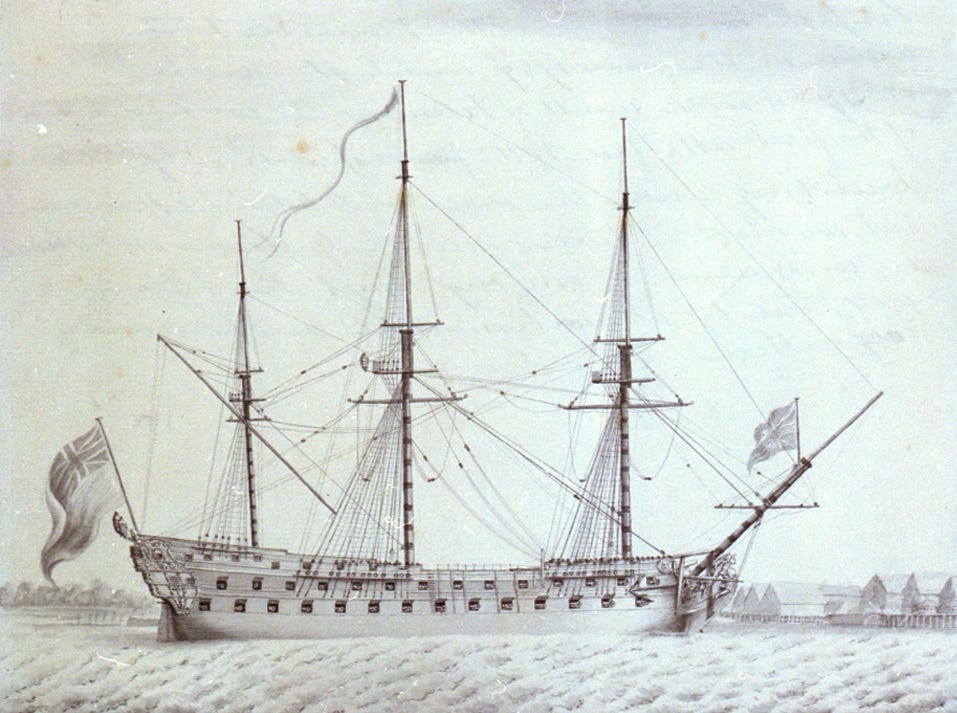
British ships tended to be shorter, heavier, and stouter than French ships of the same class. They were designed with heavy weather in mind and with staying at sea as long as possible. The quality of British rigging, masts, sails, cordage, and other shipboard necessities tended to be higher than that of the other navies—they thought the extra expense was worth it. British ships were designed for a navy that wanted to keep ships at sea in all weathers, off the enemy coast if necessary. In that, they largely succeeded.3
French ships tended to be lightly built with long hulls, suitable for high speeds in calm waters. They had inferior rigs to the British, and they lacked the robust dockyard infrastructure necessary to keep their bottoms clean and their hulls in good repair. In situations that called for quick-strike expeditions aimed at overseas targets, French ships could do well, as seen in the early years of the Seven Years War and in the middle years of the American Revolution. But French ships were not well-suited for prolonged blockades in bad weather; relatedly, French strategy almost never called for them to perform that function.
Spanish ships were big, long-lasting, and slow, built to connect an empire that stretched from Havana to Cadiz to Manila. Aided by Spain’s ability to access durable tropical hardwoods, Spanish naval architects achieved some of the most impressive designs of ships of the line of the century, including the largest ship afloat, the four-decker Santísima Trinidad of 130+ guns (though she was not a very successful design in terms of her sailing qualities).
What this means for the novels
I tend to roll my eyes whenever Aubrey admires a French ship, but that’s by no means disqualifying. In one sense, Aubrey’s admiration is an accurate representation of what many British officers said about French ships, even if they weren’t always saying that for disinterested reasons.
For Men-of-War and for his research generally into the navies of the Napoleonic Wars, O’Brian was relying on historians who told him that French and Spanish ships were “better,” so he followed along. I don’t fault him for that. It’s a minor flaw in an otherwise excellent brief survey of Nelson’s Navy.
But I hope I’ve shown that asking whether a ship design is good or bad is the wrong question. Keep that in mind the next time your navy tells you about its newest class of ships.
O’Brian, Men-of-War, 9.
N.A.M. Rodger, The Command of the Ocean: A Naval History of Britain, 1649–1815 (New York: W.W. Norton, 2004), 409, and chapter 27 generally.
Note largely: I am not saying that all British ship classes were successful.
Enjoying this series! I read O’Brian as fiction—for me the technicalities of seamanship are akin to the handwaving technobabble of Star Trek, more important for atmosphere than their accuracy. And yet the fiction is robust enough to be undamaged by the facts, and knowing more about the real Royal Navy enhances rather than reduces my enjoyment. So keep ‘em coming, hot and hot!
I grew up on the Hornblower novels and for both author and character - French frigates were in a class by themselves!