

As I did last week, I’m going to focus on this episode’s main characters. Covering the second half of 1776, episode 3 focuses on the British occupation of New York. That means the main characters are the Howe brothers: William the general and Richard the admiral.
The Howes before and after 1776
The brothers appear in the episode without much in the way of an introduction, so here’s some background.
William Howe made his name in the Seven Years War, and specifically in the British assault on Quebec. I’ve written about that campaign before:
Epiphanies and Epitaphs

I am very late to this party, but in my defense I’ve been busy. On July 4, I read and was struck by an article by the Canadian historian Peter MacLeod at War on the Rocks. It was published on that date because it argues that you can explore many of the origins of the American Revolution by looking closely at the American soldiers and sailors who were in…
Early in the morning on September 13, 1759, William Howe led British troops up the cliff above the Anse au Foulon, surprising the French defenders and setting the stage for the British victory (and Wolfe’s death, above). The point is, William Howe was unquestionably brave and bold, and willing to lead from the front.
Richard Howe also made his name in the Seven Years War, but for very different reasons. Some historians like to say that Howe “fired the first shot” of the war, but that’s a generous way to interpret what actually happened.1 In 1755, before war had been declared, the British sent a squadron under Edward Boscawen to the Gulf of St. Lawrence to prevent the French from reinforcing Canada.
Boscawen’s squadron of eleven ships of the line and one frigate sailed from Plymouth on April 26. Meanwhile, a French squadron of nineteen ships of the line (some of which had had their guns taken out to accommodate troops) left Brest on May 3. Boscawen’s head start got him to Cape Race, Newfoundland, on June 3, where, in cold and foggy weather, he dodged icebergs and waited for the French to arrive. When the fog cleared on June 8, the British spotted three French ships of the line that had become separated from the rest of the fleet. Captain Richard Howe in Dunkirk ran down the French ship Alcide. The French captain called across to Howe, asking whether the two nations were at war. At the third time of asking, Howe finally replied, “At peace, at peace!” But Boscawen’s flagship was flying a red pennant that meant attack. Howe fired a full broadside, followed by several more, which disabled Alcide and convinced her captain to surrender. In ten minutes, the Alcide suffered 54 men killed and 50 men wounded; Dunkirk suffered 9 killed and 29 wounded.2
It’s going too far to say that Howe committed a war crime, but he clearly violated norms. It’s true that both sides knew that the only reason the French squadron had sailed was because both sides anticipated the war starting soon, but firing into a French ship immediately after saying the two nations were at peace was … ok, maybe war crime is the right phrase.
Richard Howe’s career suffered no ill effects from the incident. After his experience in the American War (see below), he became First Lord of the Admiralty and then commander-in-chief of the Channel Fleet at the outbreak of the French Revolutionary Wars. He captured six French ships of the line in the battle of the Glorious First of June in 1794 and was honored by the visit of George III to his quarterdeck in the aftermath, pictured below. (Nobody mentioned that the essential grain convoy from the US to France got through…)
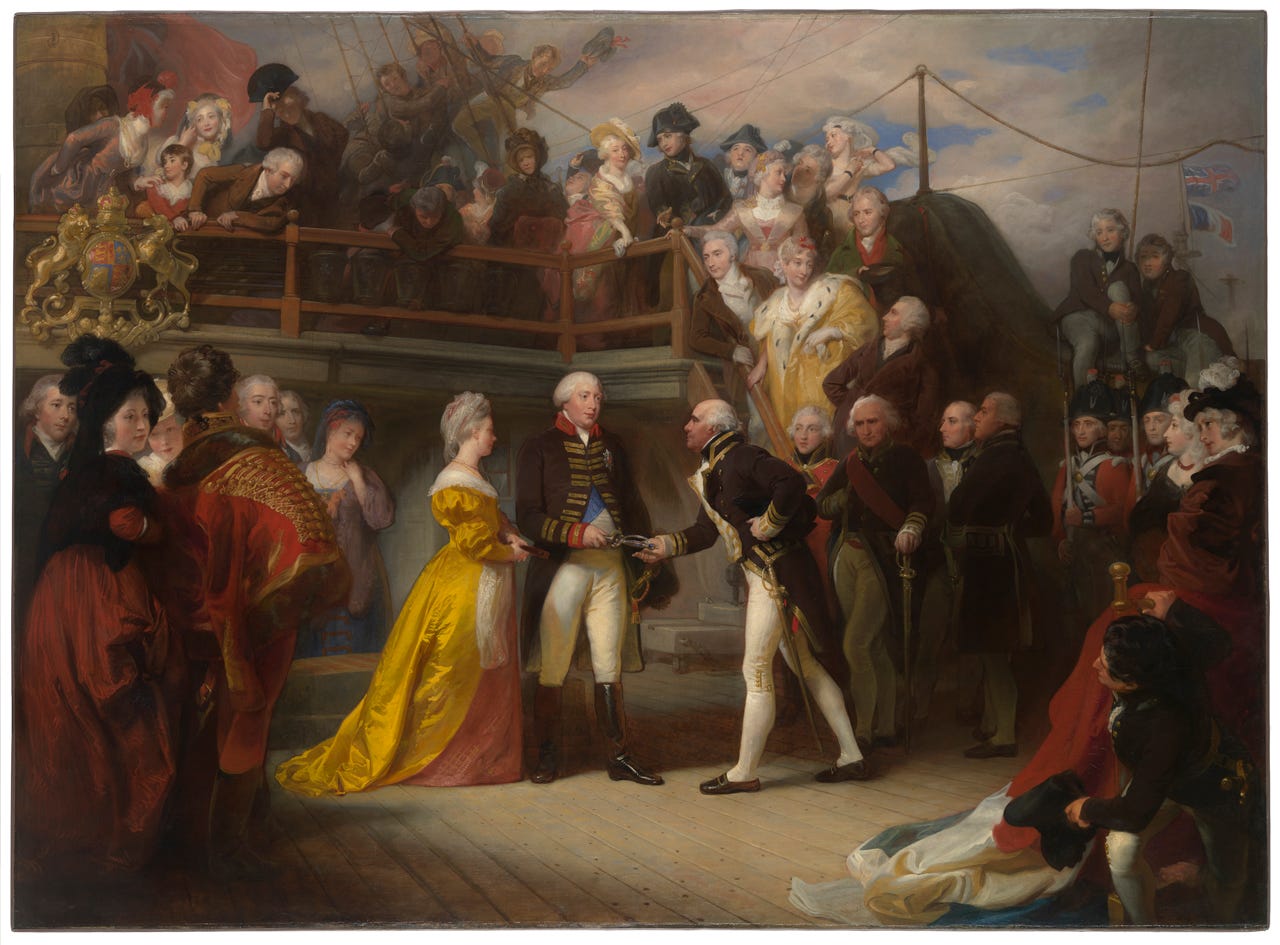
But that’s getting ahead of the story. Here are some thoughts on the Howes as depicted in Ken Burns’ documentary.
The Howes in 1776
There are two questions about the brothers that historians have spilled tons of ink answering, and that the documentary addresses as well. First, why were they not more aggressive in pursuing Washington and his army when both were trapped in the battles around New York? Second, in 1777 (covered in the next episode), why did William decide to attack Philadelphia instead of following through on the plan to meet Burgoyne’s army at Albany?
After 250 years, you would think we would have good answers to these questions. Alas. The episode does a good job of surveying some of the answers, but it doesn’t get into the weeds about why the answers are all unsatisfying. I’ll try to do that here.
Twice the episode uses voices from the time to insinuate that the Howes actually wanted to let the Americans win:
[Narrator]: General William Howe’s officers urged him to finish what he had begun, but instead of ordering an assault, Howe stood down.
He knew his brother Richard’s fleet was about to enter the East River and prevent the rebels from escaping by water.
The Americans were astonished.
“General Howe is either our friend or no general,” Israel Putnam said. “He had our whole army in his power.”
And later:
[Historian Friederike Baer]: The British essentially let Washington escape once again. Opportunities to just end this war right now are being wasted.
[Voice]: “Is it through incapacity or by design of our commander that so many great opportunities are let slip? I am inclined to adopt the latter.”
Captain William Bamford.
In the documentary, the historian Stephen Conway pushes back against Bamford’s accusation immediately after that, and he summarizes the historical consensus, which is that the Howes were not traitors. They behaved the way they did because:
The Howes’ politics made them sympathetic to the American cause;
Therefore they held out hope even after the Declaration of Independence that they could settle the dispute without too much bloodshed;
And keeping Washington at large presumably would help convince the Americans that the forces of the empire weren’t there to kill everyone.
All that seems reasonable. The Howes probably were not traitors, but rather they hoped that adopting a less-than-full-bore approach to the war would lead to a peace settlement that would keep the colonies in the empire and prevent the French and Spanish from capitalizing on the opportunity presented by the rebellion.
But the point of this post is to say that we don’t really know! And that’s both frustrating and surprising. After all, these are fundamental questions about foundational events in American history. Surely historians could give us more than speculation!
What the episode doesn’t tell its viewers is that there are two good reasons why we have to speculate about the Howes.
The first is the unusual nature of their relationship. There were excellent strategic reasons to assign brothers to these positions. The British army and Navy consistently struggled to work well together. They lacked what today’s military calls joint command and control. An admiral could not technically order a general to do anything, and vice versa. Successful operations involving both services almost invariably depended on a good personal relationship between the officers.
From London’s perspective, what better way to guarantee a good relationship than to appoint brothers?
From a historians perspective: gah! How annoying! Brothers have a tendency to, you know, talk to each other. That means they don’t write down what they’re thinking. We have to rely on accounts from members of their staff (like Ambrose Serle, the general’s secretary) to know what they said to each other. Normally, in amphibious situations, both admirals and generals wrote long explanations of why the other side was entirely responsible for everything that went wrong while they were responsible for everything that went right. That requires its own kind of parsing from historians, but at least we have evidence to parse!
The second reason is that the bulk of the Howes’ papers were destroyed in a fire in 1826. That doesn’t mean that everything the Howes ever wrote was destroyed; it just means that the largest single collection (apparently enough to fill several trunks) is unavailable to us.
And that’s why historians have to speculate about why the Howes acted as they did, and why the episode, in turn, can implicitly accuse them of treason without straying too far from the evidentiary base.
Andrew Jackson O’Shaughnessy, The Men Who Lost America: British Leadership, the American Revolution, and the Fate of the Empire (Yale University Press, 2013), 89.
Dan Baugh, The Global Seven Years War, 1754–1763 (Routledge, 2011), 111–15.