

I have been impressed with the series so far, but episode five was my least favorite. It covers the aftermath of Saratoga through French and Spanish entry and the operations in Rhode Island (1778), Savannah (1779), and Charleston (1780). As I predicted after watching episode one, when Burns reached the point in 1778 when the American Revolution became a global war, he chose to keep his focus on the thirteen colonies.
I’m a British naval historian, so naturally I had hoped he would have made a different choice. The vast majority of the interesting naval events of the war happen after 1778 and are sometimes unrelated to the thirteen colonies. Alas.
Speeding up the clock
Of course I know I’m not the target audience for the show, but that’s not the only reason I was disappointed in the episode. Compare the pacing of episodes two through four with episode five. I copied the dates directly from the episode titles:
May 1754–May 1775
May 1775–July 1776 (14 months)
July 1776–January 1777 (7 months)
January 1777–February 1778 (13 months)
December 1777–May 1780 (30 months)
May 1780–onward
Clearly they tried to pack more into episode five than into the previous three; ironically, that’s the time period when the war expands to encompass India, the Caribbean, and (most importantly) Europe.
I say most importantly because while I think it’s entirely justifiable to ignore the Indian Ocean campaign, it’s inexcusable not to spend more time explaining the geo-strategic implications of French entry. Burns didn’t have enough time to cover it in the same level of detail as he did other pivotal issues because of how he decided to carve up the narrative of the war.
Various sizes of potatoes
The strategic implications of French entry are not entirely absent, of course. Kathleen DuVal does an excellent job of setting the table, explaining how French entry relegated the fight in the thirteen colonies to a secondary theater:
Kathleen DuVal: The French decide to enter the war, and that changes everything for Britain. Britain knows that Spain and the Netherlands may be next. Suddenly, those 13 colonies that were rebelling are kind of the small potatoes of the war. They could lose their profitable plantation islands. They could lose Jamaica. The stakes are big in this war, and the 13 colonies have become just a tiny corner of it.
Yes! But then the next logical step for Burns to take would be to show that Britain’s need to focus on France and Spain meant that there were fewer forces available to deploy to North America. Moreover, it would make sense to explore how, exactly, the French and Spanish proposed to assist the Patriots, and how, exactly, Britain might need to re-think its strategy to counter them. I think that would flow logically from DuVal’s table-setting even if you adopt Burns’ focus on the thirteen colonies. After all, British, French, and Spanish strategies shaped not only Patriot and Loyalist strategies but also the outcome of the war.
Some of that happens in the next section, which covers Henry Clinton’s appointment as British commander-in-chief. The narrator mentions that Clinton decided to shift his forces south in part to reinforce the West Indies, and that he had insufficient ships to carry his army from Philadelphia back to New York. But I don’t think the narrative goes nearly far enough. After French entry, all the choices that Clinton made were made with the knowledge that a major French fleet might appear on the horizon anywhere in North America and possibly without warning. Moreover, examining Clinton’s decision-making covers just the “small potatoes” stuff—he’s at the mercy of the resources that his bosses allocated to him. The big potatoes (?) were in London, Paris, and Madrid, not New York.
Blundering aimlessly about
So let’s look at the war from London’s perspective after French entry. In 1778, the British strategic dilemma was whether to keep their forces divided on two sides of the Atlantic or to concentrate their forces in Europe.
If they kept their forces divided, then French expeditionary forces and fleets would be able to cross the Atlantic and attack British possessions or support the Patriots. However, the British would still have both naval and military forces on the western side of the Atlantic to defend their possessions and to continue to put pressure on Washington’s army. It was reasonable to think that those forces would be able to handle both Washington’s army and whatever the French sent.
If the British concentrated their forces in Europe, they might be able to bottle up the French navy as they had done in the Seven Years’ War. If they did that, then all of their possessions in the West Indies would be safe, and the French would be unable to support the Patriots. However, to achieve the necessary superiority in Europe, they would probably have to evacuate the British army from New York and leave the Loyalists to fight Washington’s army on their own.
We know what the British chose to do—George III could not countenance the idea of abandoning the colonies, so British forces remained divided—but I think there’s value in recreating that strategic dilemma. The British decision made life much more difficult for Washington’s army, which had to endure extraordinarily difficult winters at Valley Forge and Morristown. The episode does an excellent job of describing those challenges, again (understandably) maintaining its focus on the Patriot perspective. But I hope I’ve shown here that you can’t fully understand that perspective without the global context.
From a naval perspective, the British decision to keep fighting in the thirteen colonies meant that both the British and French sent squadrons across the Atlantic. Once they left European waters, it was up to the commanders to execute their missions and react to changing circumstances. And because there were lots of squadrons doing lots of different things (not to mention armies fighting in North America and the West Indies), circumstances changed frequently. The result was, as N.A.M. Rodger put it, “a series of undirected random cruises in which British and French squadrons blundered aimlessly about in the New World, occasionally encountering one another in strength and circumstances which were completely unpredictable.”1
The episode notes occasionally that both Washington and Clinton struggled to anticipate the movements of both French and British squadrons, but from my perspective, Burns missed several opportunities to explain why that was the case.
The Armada of 1779
The other great missed opportunity was the armada of 1779, which is left out of the episode entirely.
The French failed to convince the Spanish to join the war in 1778, but in 1779, the Spanish agreed. They had clear goals: recapture Minorca and take Gibraltar, Florida, and Honduras, in that order. To gain French support in achieving their goals, the price the Spanish paid was to contribute to a massive amphibious expedition aimed at capturing the Isle of Wight, which sits just outside Britain’s naval base at Portsmouth midway up the English Channel. In the summer of 1779, Louis Guillouet, comte d’Orvilliers, led sixty-six ships of the line up the Channel. His fleet was double the size of the Combined Franco-Spanish fleet at Trafalgar in 1805—in other words, sixty-six is a big number.
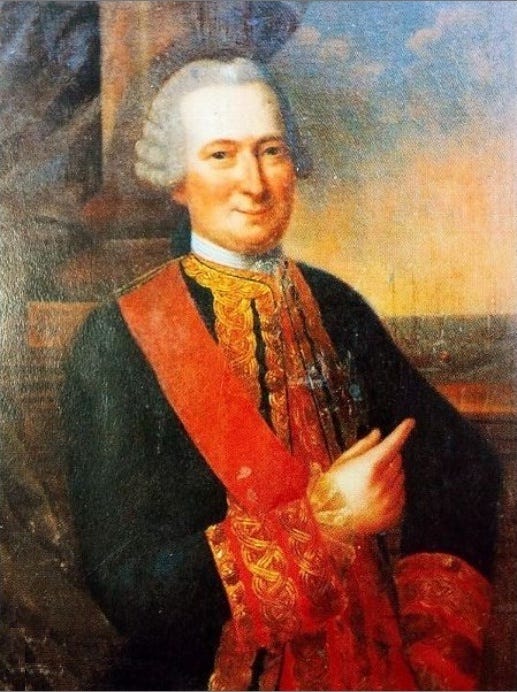
To counter it, the British could muster just thirty (later thirty-nine) ships of the line. Remember, they had chosen to keep fighting in North America and they were worried about the West Indies. Disconcertingly outnumbered in home waters, the British retreated up the Channel and waited to see what the Combined Fleet would do.
The answer, it turned out, was get sick and go home. Amphibious operations are the most complex operations that navies and armies undertake, and this one was additionally challenging because the target landing area was so far away and because there were two armies and two navies (French and Spanish) involved. Typhus killed or incapacitated nearly 8,000 men in the squadron; the rest suffered from shortages of food and water caused by French logistical failures.
Nevertheless, the British navy did functionally nothing to prevent the Combined Fleet from achieving its goals. That was, to say the least, alarming. The British public thought the entire point of having the world’s best navy was to prevent invasion. The invasion panic of 1779 gave plenty of ammunition to those who wanted to end the war in America, and it called into question the competence of Lord North’s government.
Should Burns have focused on the armada? No. After all, recall the list of Spanish war aims. Notice that “win American independence” didn’t make the list. The armada was mostly about Anglo-Franco-Spanish issues, not about American independence.
Yet I still think Burns does his viewers a disservice by neglecting the European theater so completely. Whatever odds Washington faced in any of the battles of 1778–1780, those odds were shaped by events across the ocean. Britain could not focus all its attention on the thirteen colonies (as DuVal rightly says), but exploring why that was the case seems to me to be worth some of the documentary’s precious time.
This post is already longer than usual, so I’ll leave it there for now. Next week, I’m going to return to this episode to look at how it treats the comte d’Estaing, who led the first of those “undirected random cruises” to the American coastline in 1778.
N.A.M. Rodger, Command of the Ocean: A Naval History of Britain, 1649–1815 (W.W. Norton, 2004), 357.