

As I mentioned last week, episode six omits several key characters. I’m going to focus today on the British prime minister who negotiated the treaty that acknowledged American independence, William Petty, 2nd Earl of Shelburne (1737–1805). His short tenure in office—eight months beginning July 4, 1782, of which parliament was in recess for five of them—reflected the ways the war scrambled parliamentary politics.
Enigmatic, intelligent, and indecisive, Shelburne was a voracious consumer of information. He cultivated a network of correspondents to keep himself up to date about everything from politics to science to culture. It was mostly innocuous, but it was not difficult for political rivals to wonder why he seemed to be running a domestic intelligence network. Many elites viewed him with the kind of suspicion normally reserved for characters like Varys “the Spider” from Game of Thrones; in Shelburne’s case, his nickname was “Malagrida,” or “the Jesuit of Berkeley Square.”1
He has been described as the cleverest man in public life; he was also a notably unsuccessful prime minister, thanks in large part to his complete inability to manage parliamentary coalitions.
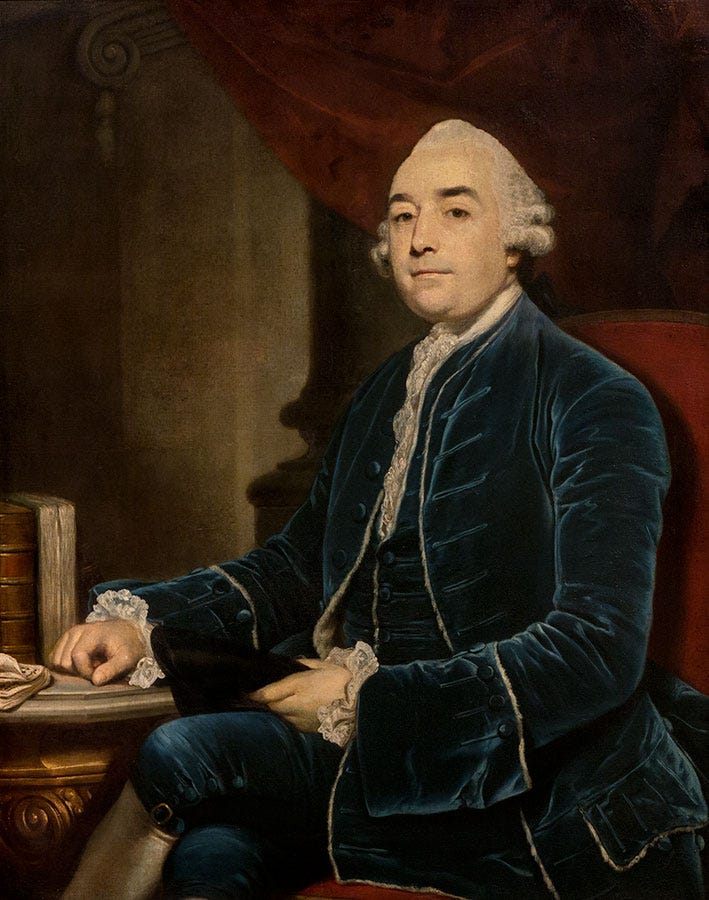

You’ll note that Shelburne does not get named in the episode’s narrative:
Narrator: Meanwhile, in Paris, Benjamin Franklin, John Adams, John Jay, and Henry Laurens were trying to work out a permanent peace. Ignoring their instructions to include the French, whose assistance had ensured their astonishing victory, the American envoys decided to negotiate alone with British emissaries.
“Let us be honest and grateful to France,” John Jay said, “but let us think for ourselves.”
They had a draft treaty within a week.
As has been the case throughout the series, Burns’ privileges the American perspective. And that makes sense—he knows his audience. But in this case, it is misleading to ignore the British side of the negotiations. By definition, negotiations require two parties! So, what was Shelburne’s government trying to accomplish?
Initially, Shelburne wanted a federal union with the colonies. They would govern themselves but still retain allegiance to London in an arrangement roughly similar to the later Commonwealth. The American team was surprised—that was an obvious non-starter for them, which Shelburne should have known2—but they recognized the opportunity to insist on independence and to use that as a lever to extract additional concessions.
The resulting treaty looked like an American victory, as the episode summarizes:
Narrator: Its terms were generous to the Americans, so generous they would cause the new British government to fall, as well. It declared the 13 former colonies “to be free, Sovereign and independent states” and set expansive boundaries, stretching all the way from the Great Lakes to Florida and from the Appalachians westward to the Mississippi, a territory larger than England, France, and Spain put together. British troops were to be withdrawn with “all convenient Speed” and were barred, the agreement said, from “carrying away any Negroes or other Property of the American Inhabitants.” This provisional treaty was signed by the American and British negotiators on November 30, 1782.
A final comprehensive treaty would not come for another 9 months.
All that appears to be disastrous for Shelburne: he gave the Americans what they wanted and then lost his job.
But by skipping over those nine months, the episode actually misses one of the strangest aspects of the American Revolution and indeed Shelburne’s cleverness. When you survey the Anglo-French rivalry of the eighteenth century, the American Revolution stands out superficially as Britain’s largest defeat—they lost the thirteen colonies. And yet, from Yorktown in 1781 until the end of the war in 1783, Britain actually did quite well! None of Britain’s victories in that period had anything to do with the thirteen colonies, but remember that despite what Ken Burns would have you think, there is a world outside of North America. From London’s perspective, the victories were quite important:
In April 1782, Admiral Rodney won the battle of the Saintes in the West Indies, severely damaging French naval power in that region. That summer, news began to arrive that the British fleet in the Indian Ocean was holding its own against Admiral Suffren. Finally, in October, Admiral Howe led the third relief of the siege of Gibraltar by delivering a convoy full of supplies to the garrison in the face of a superior Franco-Spanish fleet.
Therefore, the American negotiators’ decision to abandon their French, Spanish, and Dutch allies was actually an opportunity for Shelburne. Conceding independence to the Americans divided his enemies. Being generous to the Americans also helped keep them happily separate from their European allies. Shelburne managed to cut Britain’s losses from the war and transform the negotiations into a referendum on the state of the war in 1782 among the European powers—and there, Britain was winning.
The comprehensive treaty referenced in the episode wrapped up the war like this:
Britain: lost thirteen colonies and Minorca; kept Canada, Gibraltar and many West Indian islands; gained Dutch trading posts in India.
France: gained Tobago, St. Lucia, and some trading posts in India.
Spain: gained Minorca and Florida; gave up trying to take Gibraltar.
United Provinces: lost trading posts in India.
If you’d offered that settlement to the then-prime minister Lord North immediately after Yorktown, he would have been thrilled. As defeats go, this really isn’t that bad. Britain began the war with twenty-six colonies, Gibraltar, and its growing presence in India. Britain ended the war with thirteen colonies, Gibraltar, and its growing presence in India. Meanwhile, France ended the war financially exhausted and disappointed. Yes, prying loose the thirteen colonies had damaged British prestige, but the French empire gained very little from its enormous expenditures and effort.
All that is a long way of saying that I don’t agree with the simplistic connection between the generous terms that the Americans got and the fall of Shelburne’s government. What Shelburne mismanaged was the politics of his success. Had he explained more effectively to his political partners that conceding American independence was a way to divide Britain’s enemies and force Spain and France to settle for very little, he might have lasted longer than an ignominious eight months.
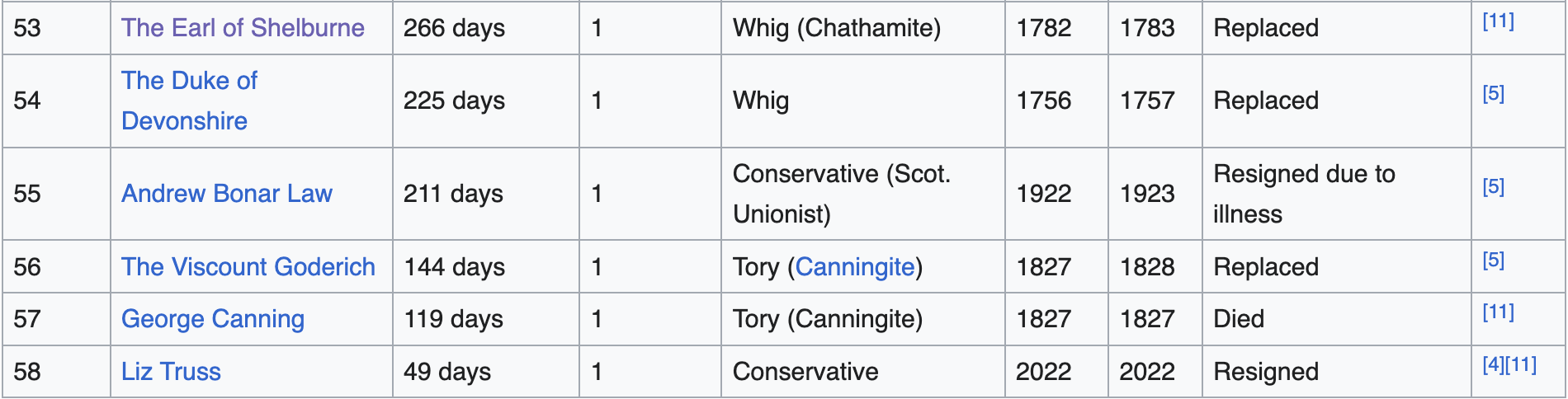
Those are the six shortest tenures of prime ministers in British history, per Wikipedia. I’m not arguing here that Shelburne was a successful prime minister, but he probably doesn’t deserve to be lumped in with Liz Truss.
The reference is to Gabriel Malagrida, an eighteenth-centry Jesuit missionary in Brazil who was widely seen as a “power behind the throne” figure—what we would now call a Rasputin.
The details here are difficult to describe concisely, but basically: Shelburne was a liberal Whig who shared some sympathy with the American cause, in contrast to the Tory Lord North who had been in charge for the entirety of the war through Yorktown. Shelburne fell into the trap of projecting his own ideas about politics on to the Americans—wish-casting, in other words, that the Americans would like to remain in the empire even as they forced through needed reforms to the British imperial and political systems.
I don’t think Ken Burns adequately addressed the French sense of being betrayed by the Americans with this separate treaty
Again, a useful take on an otherwise solid series.
To bin last week’s post and this, part of the difficulty Ken Burns faces is a general lack of awareness of naval warfare and its character. Yorktown is a land victory, crucially enabled by sea power. All the other notable Patriot victories are land battles, with the exception of John Paul Jones, and Burns would have had to explain how naval operations (as we term them today) worked.
More broadly, look at the French and Indian War, in which most North American land battles won by the English (Louisburg, Quebec, and even Ticonderoga and Niagara) had maritime components. The same could be said about the Caribbean, India, the Philippines and West Africa. But putting all of that together in a documentary tajes a lot of effort.