

As promised, here’s the second of my two critiques of episode five. You can read the first part here:

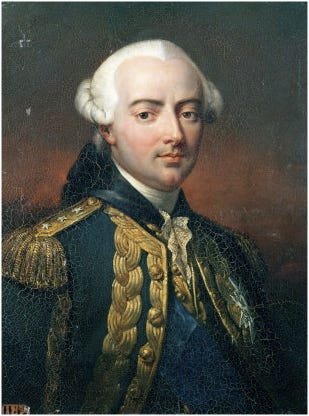
The episode’s fixation on the thirteen colonies comes with costs not only to our understanding of the global context, but also to the perspectives that the narrator and the historians bring to bear. Nowhere is that more true than when the episode discusses Charles-Henri, comte d’Estaing, the French admiral who led the first major expedition to support the Patriots in the spring of 1778.
My argument, in brief, is that the episode provides the Patriot perspective on d’Estaing but not the French perspective.
_(par_Jean-Pierre_Franque).jpg)
D’Estaing in New York
Here’s how the episode introduces d’Estaing:
The French fleet Washington had been waiting for finally appeared off New York in the week after Independence Day [1778]—12 ships of the line, 4 frigates, and over 4,000 French marines, all commanded by Vice Admiral Charles-Henri, comte d’Estaing, a veteran of warfare against Britain in India and Sumatra.
Iris De Rode: D’Estaing is a French aristocrat. He considers himself quite superior to these American “ragtag” army and is looking at them and thinks, “How am I gonna work with these people?” Because he thought, “I’m the French admiral. I know what to do here, so they better listen to me.”
Let’s handle the second paragraph first. I will freely admit that d’Estaing is not a particularly likable character, and he certainly carries with him the arrogance you would expect from a high-ranking French aristocrat. Louis XV thought so highly of him that he created a new position for him as one of the three most senior admirals in the French navy. And it is true that he had plenty of combat experience up to that point.
However, the idea that his fleet “appeared” off New York, as a bolt from the blue, gets us off on the wrong foot. It gives the impression that the arrogant d’Estaing never even considered coordinating with his American allies. The narrator doubles down on that impression when describing how d’Estaing approached British forces in New York:
Narrator: Washington hoped a coordinated attack with this new French force could trap Clinton in New York, take back the city, and, by so doing, persuade Britain that further prosecution of the war was hopeless.
Because d’Estaing had convinced himself that his heaviest ships would run aground trying to enter New York Harbor, he decided to move against the British garrison at Newport, Rhode Island, instead.
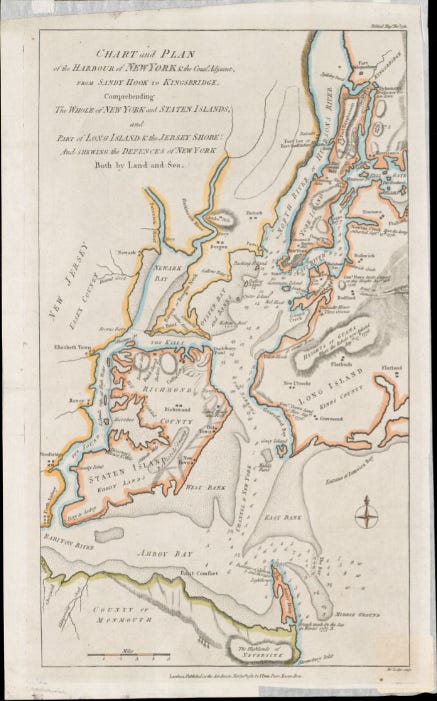
There are two problems here. First, d’Estaing’s landfall on the east coast was not New York but rather the Delaware Capes, where he discharged Conrad-Alexandre Gérard, the minister plenipotentiary to the Continental Congress, up the Delaware river. That’s about as coordinated as you can get in the eighteenth century: here’s a minister empowered to make decisions sent directly to the Patriot seat of power!
Second, as you can see in my bolding above, the narrator blames d’Estaing for not attacking the British in New York. While it is true that Washington was disappointed that d’Estaing couldn’t get over the bar, it wasn’t for lack of trying! In fact, d’Estaing was so eager to get at Admiral Howe’s inferior fleet (which had anchored itself just inside Sandy Hook in New Jersey) that he offered American pilots ever-increasing sums of money to get his fleet over the sandbar. The pilots did the math in terms of how much the French ships drew and how deep the water was, and declined.1
D’Estaing in Rhode Island and Massachusetts
Here’s how the episode describes d’Estaing’s arrival off Rhode Island:
Narrator: It was to be a coordinated assault with American ground forces under General John Sullivan, but neither commander spoke the other’s language. Sullivan, the son of Irish indentured servants, loathed aristocrats like the French commander, who, in turn, found Sullivan crude and inept.
[Cannon fire] It all went wrong. Without informing the French, Sullivan advanced a day earlier than had been planned. When a British fleet appeared offshore, d’Estaing sailed out to do battle... [Thunder] but a howling storm scattered and seriously damaged both fleets.
Franco-American coordination was poor, it’s true. And figuring out who was going to attack when and where was challenging. Nevertheless, the episode gives the impression that d’Estaing barely engaged British forces in Newport and chose to abandon Sullivan instead.
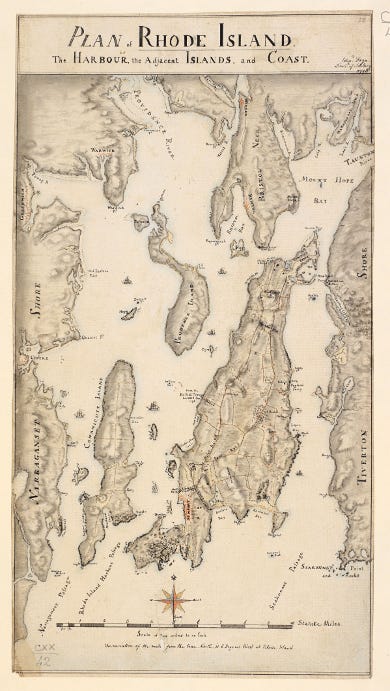
In fact, d’Estaing (who had no knowledge of the tricky waters of Narragansett Bay) blocked all three channels into the bay, causing the British to burn four frigates and sink ten transports2—the single biggest loss of British naval vessels up to that point in the war.
D’Estaing entered the main passage with eight ships of the line and engaged the British batteries guarding Newport harbor. He was all set to finish off the city when, unexpectedly, Admiral Howe appeared off the coast with reinforcements from Britain under the command of Admiral John Byron.3
Because French and American intelligence had so comprehensively failed to alert d’Estaing to Howe’s arrival, d’Estaing worried that he was going to be trapped in unknown waters between British shore batteries and a superior British fleet. So yes, it is true that he “sailed out to do battle,” but it wasn’t because he was some glory-seeking knight off to single combat—it was for legitimate tactical reasons.
I happen to disagree with d’Estaing’s choice (we now know that he was still superior to Howe) but I also think he had plenty of reasons to proceed with caution. Yes, he abandoned Sullivan, who had to retreat off Aquidneck Island in the Battle of Rhode Island a few weeks later. But he didn’t do that out of spite or out of haughty disdain for the American cause. I think the episode does d’Estaing a disservice here:
Edward Lengel: The French, in essence, leave the Americans in the lurch. Sullivan is barely able to extract his forces from what could have been a catastrophe.
It doesn’t get better in the next paragraph, which discusses d’Estaing’s departure for the West Indies in November 1778:
Narrator: The first joint French-American operation had failed. Once the repairs were finished in Boston, d’Estaing would set sail for the French West Indies without even bothering to tell Washington he was leaving.
There are lots of interesting details that the episode skips over here—the Bostonians did not provide a warm welcome to the French sailors, and d’Estaing’s time repairing his squadron was marred by riots and diplomatic crises—but the idea that d’Estaing left “without even bothering to tell Washington he was leaving” is false. In fact, the French (and the Bostonians) were worried that Byron would attack Boston—which in fact he tried to do, losing a 64-gun ship in the process—so d’Estaing’s first priority was to repair the fleet while maintaining the defenses of Boston.
Meanwhile, in Philadelphia, Gérard, the marquis de Lafayette, and Congress contemplated an attack on Canada. Representatives from what had been French Canada visited d’Estaing in Boston, and in late October he issued a proclamation that was intended to make the British think that in fact Canada was his next target. That bought d’Estaing time to get the fleet to sea and turn south for the West Indies without being intercepted by Byron.4
In any case, it’s impossible to get a fleet ready for sea without the port of departure noticing preparations and asking questions. It simply isn’t the case that d’Estaing bolted from the American theater without telling his allies.
So what?
I’m working on a side project on d’Estaing at the moment, so I’m more sensitive to what the episode says about him than I would be normally. I’m not throwing the entire episode in the bin because Burns’ team got some details wrong about a now-forgotten French naval officer.
However, I think the missteps here are indicative of the broader structural problem of telling the story of the American Revolution after 1778 from the thirteen colonies outward. Burns has distinguished talking heads say that after French entry it was a global war, but he never grapples with the implications of that statement. The result is that he leaves his viewers with a distorted understanding of the war’s course and outcome.
John B. Hattendorf, Newport, the French Navy, and American Independence (Newport, RI: The Redwood Press, 2005), 1–38.
The poet Lord Byron’s grandfather.
Henri Doniol, Histoire de la participation de la France à l'établissement des États-Unis d'Amérique: correspondance diplomatique et documents (Paris: Impremerie Nationale, 1886–1892), Volume 3: 417–25. I thank John Hattendorf for the reference.