

Episode four spends a long time with the armies in the campaigns of 1777, culminating at the pivotal Patriot victory at Saratoga. I was struck by this passage in which the narrator highlights the socio-economic differences between the Minutemen of Lexington and Concord and the rank and file of Washington’s army by mid-1777:
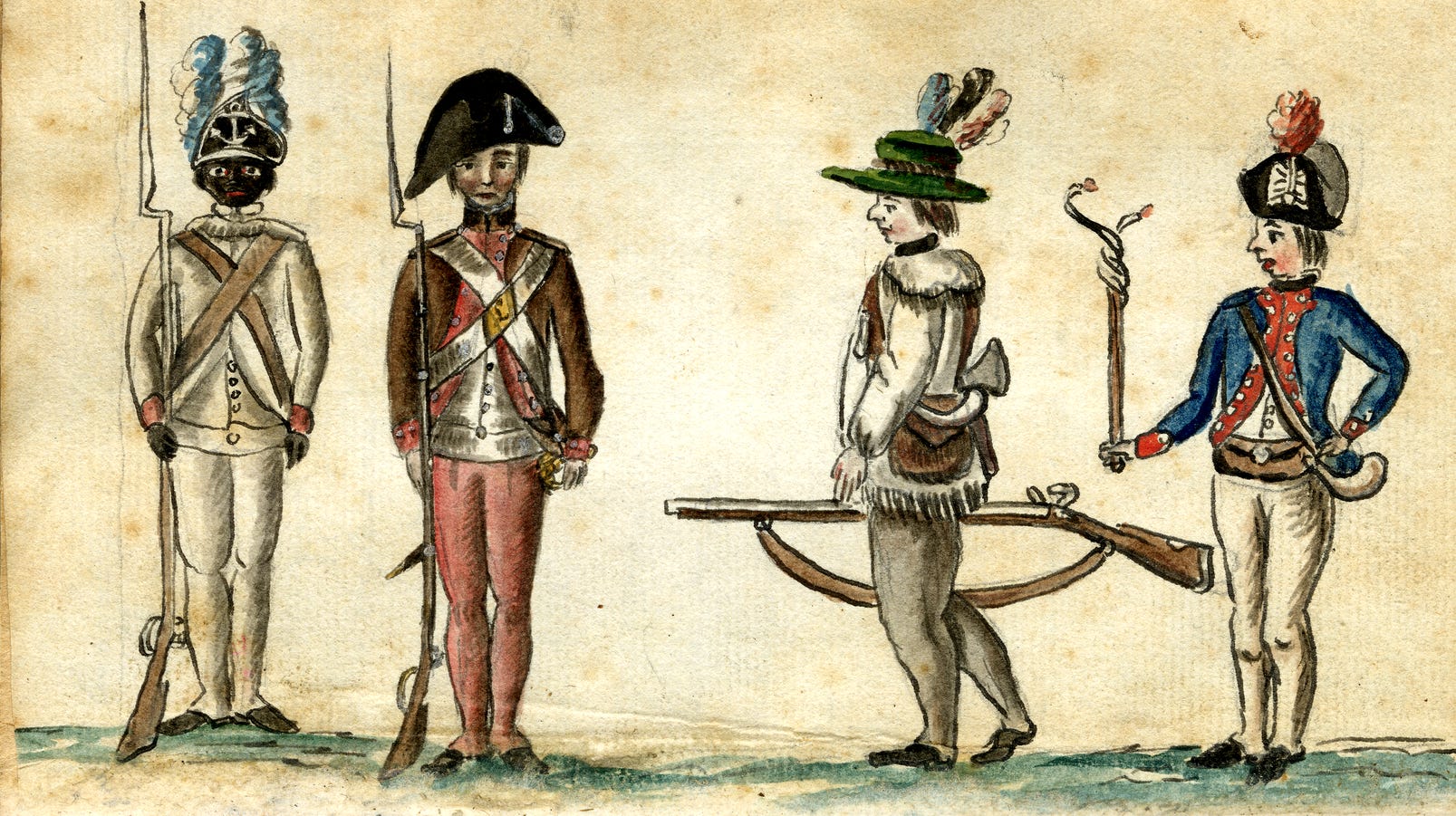
Narrator: These soldiers were different from the men who had rallied after Lexington and Concord.
Most of them had been farmers and artisans, propertied men with taxes to pay, creditors to appease, crops to sow and harvest.
From now on, the Continental Army would be made up predominantly of the poorest of the poor—jobless laborers and landless tenants, second and third sons without hope of an inheritance, debtors and British deserters, indentured servants and apprentices, felons hoping to win pardons for their service, immigrants from Ireland, and immigrants from Germany, or their descendants who had never learned English.
John Adams had worried that only “the meanest, idlest, most intemperate and worthless men” in America could ever be persuaded to serve more than a year.
But victory would be impossible without them.
,_by_Jean-Baptiste-Antoine_DeVerger_(cropped1).png)
Adams’ worries reflected the risks he was running. Before the Revolution, as a well-to-do lawyer and member of the colonial elite, he could fairly easily insulate himself from the working class. In the Revolution, though, suddenly his life depended on the performance of “the meanest, idlest, most intemperate and worthless men.”
The same was increasingly true for elites across Europe and the Americas in the revolutionary turmoil of the period 1770 to 1830.1 Adams legitimately feared execution if the Patriots lost the war. A dozen years later, the French Revolution raised the stakes of European war even higher—Robespierre and Danton were lawyers much like Adams.
The point is, the makeup of a country’s army might be the difference between life and death for more than just the rank and file.
The Scum of the Earth
As a result, Adams was not the only member of the elite to comment on the character of the rank and file during this period. When I heard Adams’ line about “worthless men,” I immediately thought of a similar episode in British history. Here’s how the Duke of Wellington described the British army he was commanding in 1813:
I don’t mean to say that there is no difference in the composition or therefore the feeling of the French army and ours. The French system of conscription brings together a fair sample of all classes; ours is composed of the scum of the Earth, the mere scum of the Earth. It is only wonderful that we should be able to make so much out of them afterwards. The English soldiers are fellows who have enlisted for drink, that is the plain fact, they have all enlisted for drink.2
Readers don’t like block quotes (how many of you skipped it?) so historians have tended to shorten the quote to the punchiest phrase, which I bolded to get you to read it.
As you can see, though, there’s more in the quote than “scum of the earth.” Some historians have noticed the other parts of the quote while others have left them out, but few have been able to resist using it in their discussions of the makeup of the British army.
For the next bit of this post, I’m going to survey the different ways that historians of the British army have interpreted Wellington’s quote. I admit that it’s not directly connected to the Continental Army in 1777, but I don’t think it’s too much of a leap to transpose some of these interpretations of Wellington in 1813 to Adams in 1777.
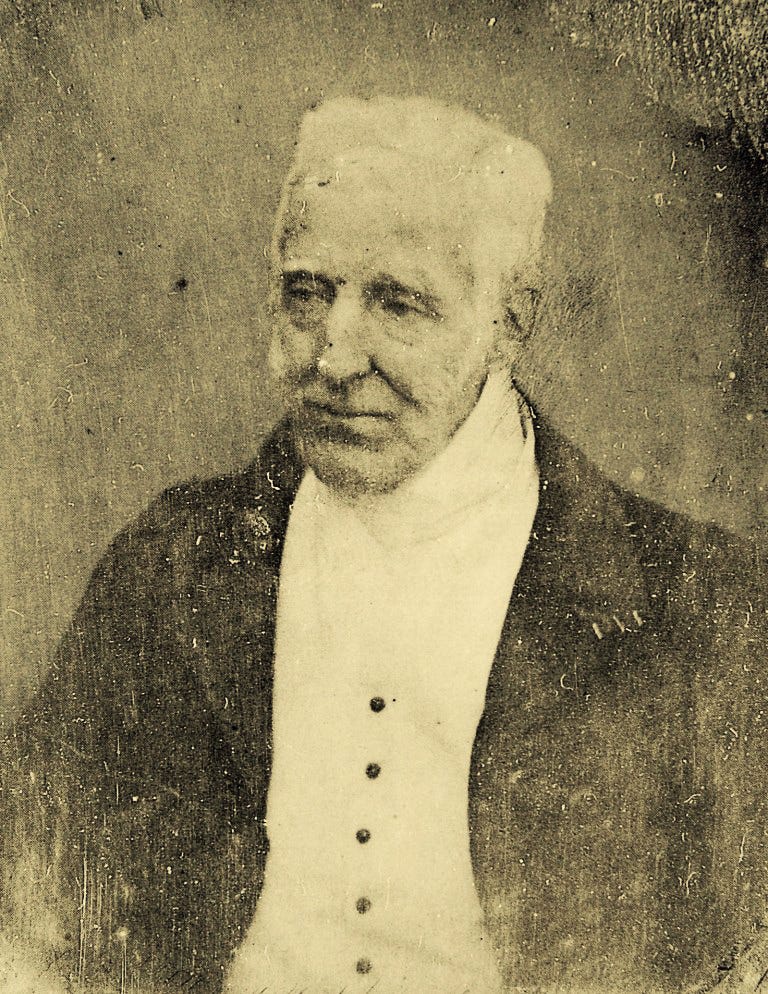

The most straightforward interpretation is that when Wellington says his soldiers were the scum of the earth, he’s stating a simple fact about the class differences between him and his soldiers. Literacy rates in the British army don’t seem to have been higher than fifty percent.3 Moreover, as we have discussed here before, probably they were drunk: “they have all enlisted for drink.”
Of course, the British army of 1813 was on the cusp of its most famous victory. How could it have won such a victory with “mere scum”? Well, some historians have given Wellington credit. Here’s Huw Davies: “Wellington had moulded an army from a rabble composed of the ‘scum of the earth’, had trained it in the course of six years of high-intensity warfare, had developed his tactical prowess from defensive to offensive, and had worn down, divided, and all but annihilated an opponent whose ubiquitous military skill had conquered much of Europe.”4
Kevin Linch and Matthew McCormack have pointed out that Wellington’s quote really talks about the men before they enlisted. They focus on the line that immediately follows the scum of the earth, though they use a slightly different version: “It is really wonderful that we should have made them the fine fellows that they are.” Service in the army made them worthy.5
Another strand of scholarship has taken the scum of the earth at more or less face value but then noted that improving the moral, physical, and spiritual qualities of the army’s rank and file became a preoccupation for reformers after the war.6 Finally, still other historians have rejected the idea that they were scum of the earth entirely. J.E. Cookson looked at pension records and argued that many were (or became) law-abiding respectable citizens.7
So there you have it, the full spectrum of historical interpretation. Either the British army was desperately lucky to have won with such a ragged crew, or Wellington was brilliant to win with such a ragged crew, or Wellington was a genius to train them into not a ragged crew, … or maybe they weren’t ragged at all! Phew. Historians are the worst.
Back to the Continental Army in 1777
What does this tell us about John Adams’ fears? Well, I’m speculating here. I know a lot more about the British army than the Continental Army, but I think you can see why Ken Burns’ writers liked Adams’ “worthless men” quote:
It highlights the actual change in the kind of men volunteering for service after the heady days of 1775–76;
It makes the achievement of American independence seem all the more impressive, since the Continental Army was a ragged rabble;
It gives implicit credit to George Washington and other generals like Benedict Arnold and Horatio Gates for turning such a rabble into an effective fighting force that won the important victories (and survived the defeats) of 1777;
It defines the social distance between Patriot leaders and the men on whom their success depended.
While Adams thought the soldiers were worthless, he might not be the best person to make that assessment given his socio-economic status and race. If the Continental Army was a true reflection of the society it served, and it endured through the hardships of 1777, then perhaps its men weren’t worthless at all.
Jürgen Osterhammel, in his astonishing global history of the nineteenth century, calls this period the “Sattelzeit,” or saddle period, in which many of the forces that characterized the mid-nineteenth century first emerged. Others have called 1770–1830 the Age of Revolutions, and still others the Age of Goethe (he died in 1832).
Quoted in Gareth Glover, Waterloo: Myth and Reality (Pen & Sword, 2014), 34.
Edward Coss, All for the King’s Shilling: The British Soldier under Wellington, 1808–1814 (University of Oklahoma Press, 2010), 8–9, 29–30.
Huw J. Davies, Wellington’s Wars: The Making of a Military Genius (Yale University Press, 2012), 211.
Kevin Linch and Matthew McCormack, “Wellington’s Men: The British Soldier of the Napoleonic Wars,” History Compass 13, no. 6 (2015): 289.
Peter Burroughs, “An Unreformed Army? 1815–1868,” in David G. Chandler, ed., The Oxford History of the British Army, new edn. (Oxford University Press, 1994), 170–76.
J.E. Cookson, “Early Nineteenth-Century Scottish Military Pensioners as Homecoming Soldiers,” The Historical Journal 52, no. 2 (2009): 335–36.
Loving this series! I took up watching the program through the holiday break and have enjoyed coming here for extra background afterwards!