

I liked episode six much better than episode five. I didn’t have any strong reactions to its interpretation of the end of the war, and it hit the high points (Benedict Arnold, Yorktown, Newburgh) well. However, to tell that story concisely and to keep the focus on the aspects of the Revolution that a broad American audience cares about, the writers could not cover several important but less-well-known characters and episodes.
Here are two omissions that I noticed that you might find helpful to supplement episode six. I’ll cover a third in next week’s post.
The poor chevalier de Ternay
In the summer of 1780, the French sent their second major expedition to North America to support the Patriots. The British had abandoned Newport in 1779, and so, armed with the knowledge of Narragansett Bay that they had gained on the first expedition in 1778, the French were able to occupy Newport with 4,600 officers and men. It was a useful base for operations on the eastern seaboard, but it wasn’t obvious what the best target for a Franco-American attack would be. To sort that out, here’s how the episode describes what happened:
Narrator: On September 21, 1780, Washington and four of his closest aides met in Hartford, Connecticut, with General Rochambeau and his entourage. The French army remained in Newport. Washington’s army was arrayed around New York.
For two days, the allied commanders discussed what steps they might take together to defeat the British. Washington and Rochambeau agreed that the most important objective was still New York City, but before an assault could take place, they would need to have naval superiority and a far larger combined army. Washington begged Rochambeau to ask his king for more help. Rochambeau said he would try.
That’s a broadly accurate summary of the meeting (an original account of which is available here) except for one key point: there was another senior French official present at the meeting. He was the commander of the naval forces in Newport, the chevalier de Ternay.
You might expect me to get up in arms about the omission of a naval officer—after all, that’s pretty much the point of this whole Substack enterprise. Moreover, the document linked above begins, “Summary of a Conversation between His Excellency General Washington, The Count De Rochambeau & The Chevalier De Ternay.”
But actually I totally understand why they left de Ternay out of the story. It’s a great illustration of the challenges that academics face when trying to tell a story for a broad audience. The academic in me wants to make sure that everyone knows that there was a third person at that meeting who mattered a lot at the time. Meanwhile, public-facing historians look ahead and notice that there’s no reason to add another French name to the story. And why is that? Well, after failing to come to an agreement about where to attack in September, the French spent the winter in Newport. On December 15, 1780, de Ternay died of typhus.
There was no Catholic church in Newport, so the French chose the fanciest church in town, the Anglican Trinity Church, and buried de Ternay there. Louis XVI had a grand gravestone designed for him, which you can see today in the narthex. The gravestone in the church yard is modern, placed there to keep the original out of the elements:
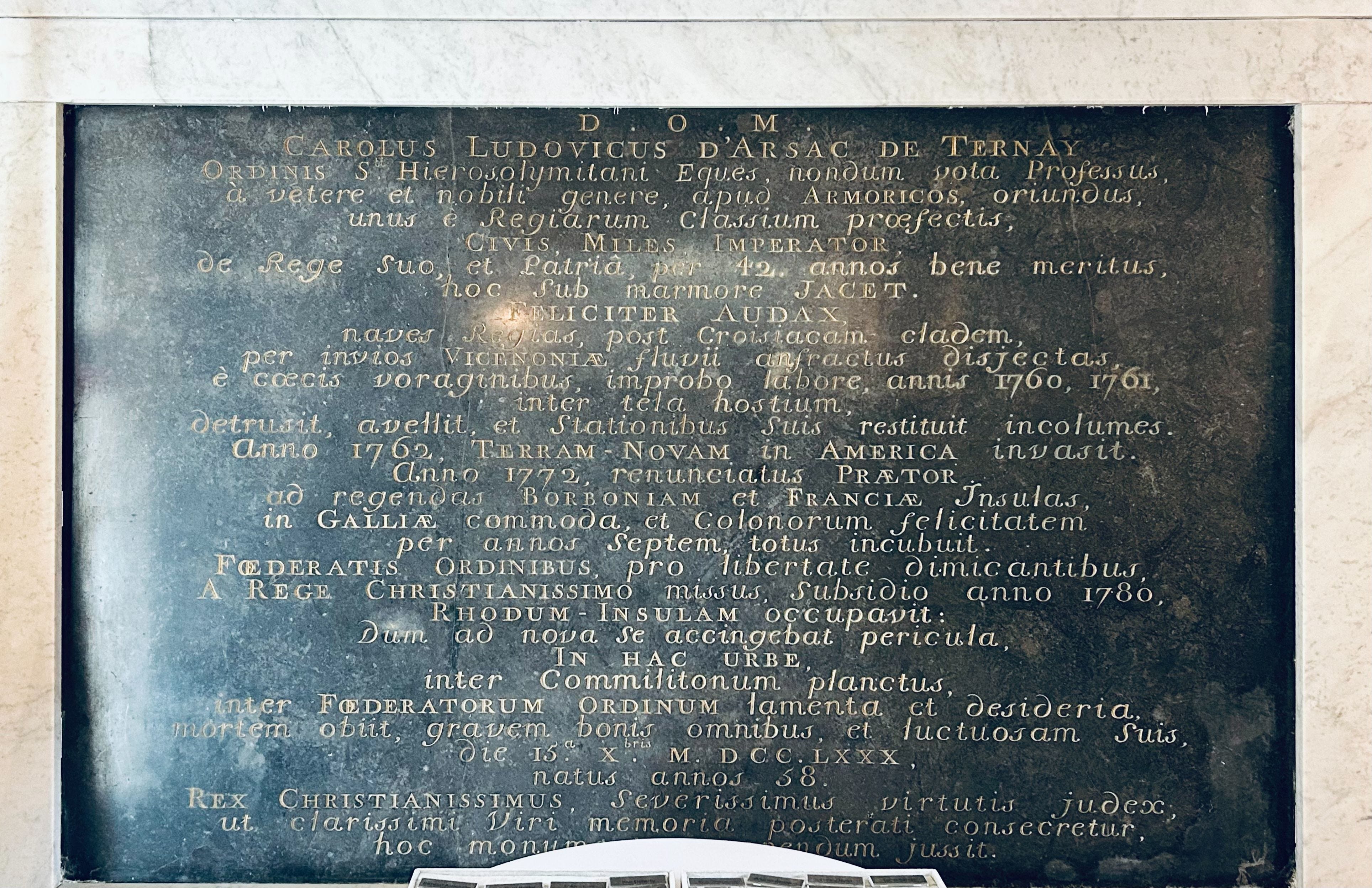
Command of the naval portion of the expedition transferred to the second-in-command, the chevalier Destouches—and he’s not mentioned by Burns either. By omitting de Ternay and omitting Destouches, Burns and his writers committed themselves to a narrative arc with two consequences:
Rochambeau became the stand-in for French commanders. Even though he was by no means the only decision-maker on the French side, it simplifies the story to say “Washington and Rochambeau agreed…” and “Washington begged Rochambeau…” etc.
Destouches’ subsequent contribution to the campaign also got omitted. If your viewers don’t know about de Ternay, it’s hard for them to be introduced to Destouches.
What did Destouches do, you ask?
The First Battle of the Capes
After the failure of the September 1780 conference, Washington, Rochambeau, and Destouches tried again. This time, in March 1781, Washington came to Newport. Greeted by cheering crowds, he reviewed the French troops. They discussed intelligence that there was a small British army recently landed in the Chesapeake that was isolated and might be a suitable target for a Franco-American attack.
Those familiar with the Yorktown campaign might think that this was the prelude to that battle. In fact, though, this army was commanded by Benedict Arnold, not Lord Cornwallis, and it was in Portsmouth, Virginia, not Yorktown.
Washington asked Destouches to move quickly, which he did. Destouches sailed from Newport on March 8 and arrived off Cape Henry, the southern mouth of the Chesapeake, just over a week later. But his departure from Newport had been spotted by British frigates, who told Vice-Admiral Mariot Arbuthnot in New York. He sailed on March 10 and managed to beat Destouches to Cape Henry. The two fleets fought an indecisive action known as the Battle of Cape Henry that prevented Destouches from landing any soldiers to attack Arnold. Frustrated, he returned to Newport, while Arbuthnot successfully evacuated Arnold.
This operation should have sent alarm bells ringing throughout the British chain of command in North America. It demonstrated that while the French remained in Newport, the British army was no longer safe when it reached the water (as had largely been the case since the beginning of the war). Arbuthnot had been lucky to beat Destouches to the Chesapeake, and since the French retained the initiative, he might not be so lucky next time.
Sure enough, that’s what happened at Yorktown. The Battle of Cape Henry was a dress rehearsal.
And that’s, of course, why Burns omitted it. Wars are incredibly complicated, and there’s never enough time to talk about every battle. Nevertheless, when I give tours of colonial Newport, I like to highlight that the French sailed from Newport not once but twice in 1781.
Next week I’ll look at another missing figure from episode six, Lord Shelburne.