

On the first leg of Surprise’s voyage to India, Stephen Maturin contemplates the unhappy Lieutenant Nicolls and reflects on his experiences with naval officers:
Stephen had thought [Nicolls] a typical sea-officer, somewhat reserved but good company, one of those who naturally combined good breeding with the necessary roughness of their profession, with a bulkhead between the two. Typical sea-officer: the phrase was not without meaning, but how to define it?1
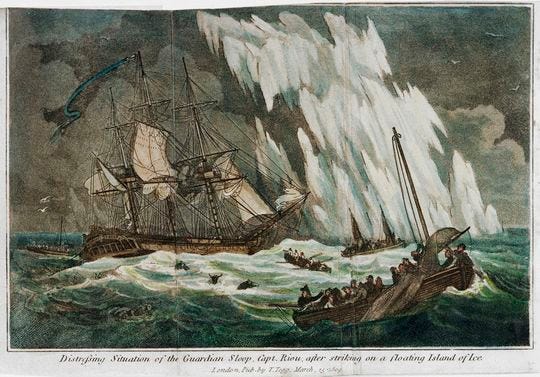
He then contemplates and rejects Thomas, Lord Cochrane as atypical (about which more next week, and if you need a refresher, read this). The three officers who seem to Maturin to be “typical” are Dundas, Riou, and Seymour. Each was a captain in the French Revolutionary or Napoleonic Wars who distinguished himself through one or more acts of conspicuous bravery. Heneage Dundas made his name when the Queen Charlotte caught fire in 1800.2 Edward Riou survived an unusual shipwreck on an iceberg en route to Australia in 1789 before being killed at the Battle of Copenhagen in 1801. We covered the frigate captain Sir Michael Seymour in the Author’s Note post.
If we take Maturin’s internal monologue to be closest to O’Brian’s own thoughts, which seems to be a reasonable assumption, then we can say that O’Brian initially concludes that typical naval officers were similar to Jack Aubrey: brave men, rough around the edges, but generally friendly and open. That is obviously too simplistic, and Maturin (O’Brian) realizes as much a few pages later: “I went on to reflect that the typical sea-officer is as rare as your anatomically typical corpse; that is to say, he is surrounded by what for want of a better word I may call unsatisfactory specimens, or sub-species.”3
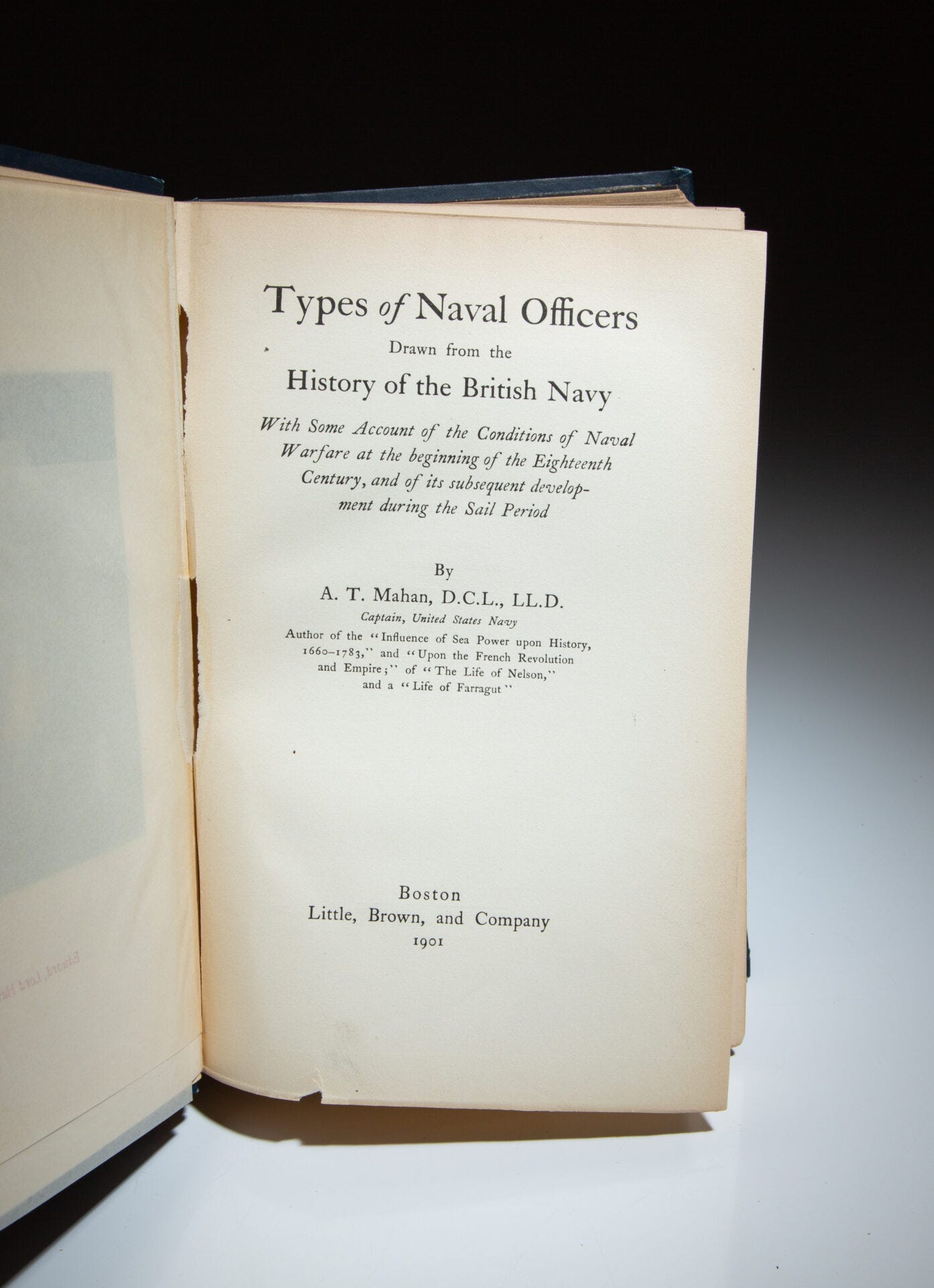
The squall that kills Nicolls and nearly kills Maturin eventually interrupts his thoughts. But as a professional naval historian, when I read Maturin’s musings on “typical” naval officers, I immediately thought of a classic work of naval history. I suspect, but I do not know, that O’Brian had the same work in mind when he wrote these pages. That work is Alfred Thayer Mahan’s Types of Naval Officers, Drawn from the History of the British Navy.
Conspicuous Exemplars
By the time it appeared in 1901, Mahan was already world famous thanks to his bestselling books on the history of sea power. This book was an attempt to identify the various specializations that made up a naval service through a series of short biographies of leading naval officers. As with most of Mahan’s writings, his target audience was primarily his own navy. He says in the preface that even though the biographical sketches cover British officers, American officers should read about them and learn from their experiences. He explains that “it is as individual men, and as conspicuous exemplars—types—of the varied characteristics which go to the completeness of an adequate naval organization, that they are here brought forward.”
Mahan’s exemplars were as follows:
Edward Hawke: The Spirit
George Rodney: The Form
Richard Howe: The General Officer, as Tactician
John Jervis: The General Officer, as Disciplinarian and Strategist
James Saumarez: The Fleet Officer and Division Commander
Edward Pellew: The Frigate Captain and Partisan Officer
I won’t go into detail on each of these, especially since I’m writing a biography of Jervis and so detail would quickly spiral into 60,000 words. But I will say this: some of Mahan’s choices here are deceptive. You might assume, when picking from the long and distinguished history of the British navy, that Mahan would have chosen exemplars who were good at what they exemplified. You would be wrong—most of them were, but not all.
Admiral Lord Howe (1726–1799) had a long and distinguished career, serving at sea in four major wars and winning a major fleet battle in 1794.4 Mahan praises his defensive work in the summer of 1778 when he managed to defend New York and relieve a besieged British garrison in Rhode Island, all while commanding an inferior squadron. Mahan concludes that this campaign forms “Howe’s highest title to fame, and his only claim as a strategist.”5 But the reason Howe is Mahan’s exemplary tactician is that, as a senior admiral, he wrote highly detailed orders that attempted to solve the longstanding problem of commanding large fleets in the smoke and confusion of battle. The idea was that the flagship could raise just a few flags to indicate a paragraph in the book of standing orders, which each ship in the squadron carried. Subordinate officers could then flip to the paragraph and respond accordingly.
That was a good idea, so long as the orders covered all contingencies.6 But a combination of the impossibility of doing exactly that and Howe’s hopelessly turgid writing style, even by eighteenth-century standards, meant that his system never quite worked. Here’s a sample paragraph in his orders:
Limitation to place and distance in order of battle in some occasions dispensed with:
The chief purpose of the establishment of a regular disposition of the ships limited to place and distance in a stated order of battle has been that they may remain as little as possible exposed in their approach to the fire of more than the particular ships corresponding in station to them in the enemy's line, or be subject to injury from each other. But as a strict adherence thereto may sometimes be found prejudicial to the service, by restraining the captains from taking advantage of the favourable incidents which may occur in the progress of a general action, it is the object of these instructions to facilitate the means of improving similar opportunities by an authorised deviation from such restrictive appointments occasionally.7
That is not a clear order, and unsurprisingly, Howe’s subordinates struggled to understand his intent. Mahan is right to say that Howe was the type of naval officer who focused his efforts on tactical reforms, but from that does not follow that he was an effective tactician.
Where’s Nelson? Well, Mahan was looking for types, and he thought Nelson was atypical, a “prodigy.” Instead, he wove Nelson throughout the book. Here’s the first paragraph of his short biography of Jervis:
The renown of Nelson is part of the heritage of the world. His deeds, although their full scope and real significance have been but little understood, stand out conspicuous among a host of lesser achievements, and are become to mankind the symbol of Great Britain’s maritime power in that tremendous era when it drove the French Revolution back upon itself, stifling its excesses, and so insuring the survival of the beneficent tendencies which for a time seemed well nigh lost in the madness of the nation.8
Again, that’s the Jervis chapter. The point is, when O’Brian has Maturin reflect on the types of naval officers, he’s likely referencing this (slightly odd) Mahan book, which attempts to sort leading British naval officers into professional specializations. As a teaching tool, Mahan’s book effectively illuminated a variety of professional models for mid-career naval officers. That makes it fundamentally different from what Maturin (O’Brian) is doing in the novel, so I’m not claiming that Maturin (O’Brian) was engaging directly in a Mahanian exercise. But O’Brian was musing on the inspirations and models for his characters, as well as how life at sea shaped the men who commanded the navy’s ships.
HMS Surprise, 109.
In the fictional Aubrey-Maturin universe, O’Brian uses Heneage’s connection to the Dundas family to make him the son of the First Lord of the Admiralty Henry Dundas, Lord Melville, but in reality he was a distant relation.
HMS Surprise, 111.
Well, sort of. At the “Glorious First of June,” the British fleet inflicted more casualties on the French fleet, but the convoy the French were protecting made it safely to port.
A.T. Mahan, Types of Naval Officers, Drawn from the History of the British Navy (Boston: Little, Brown, 1901), 283.
Howe’s system predated the system that Nelson used to send his famous “England expects” signal.
Julian S. Corbett, ed., Signals and Instructions, 1776–1794 (Navy Records Society, 1908), 319.
Mahan, Types of Naval Officers, 320.