

I was very happy to get this box in the mail on Saturday:
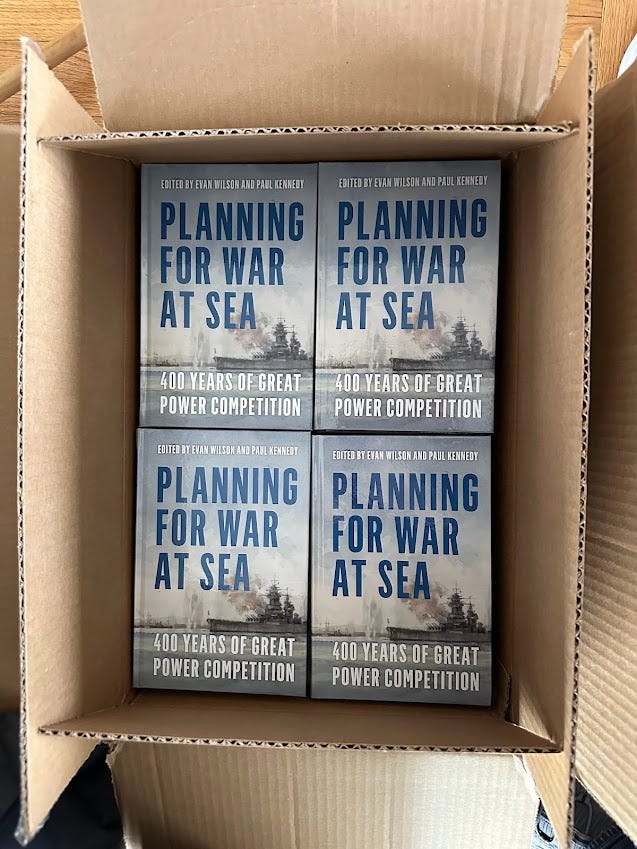
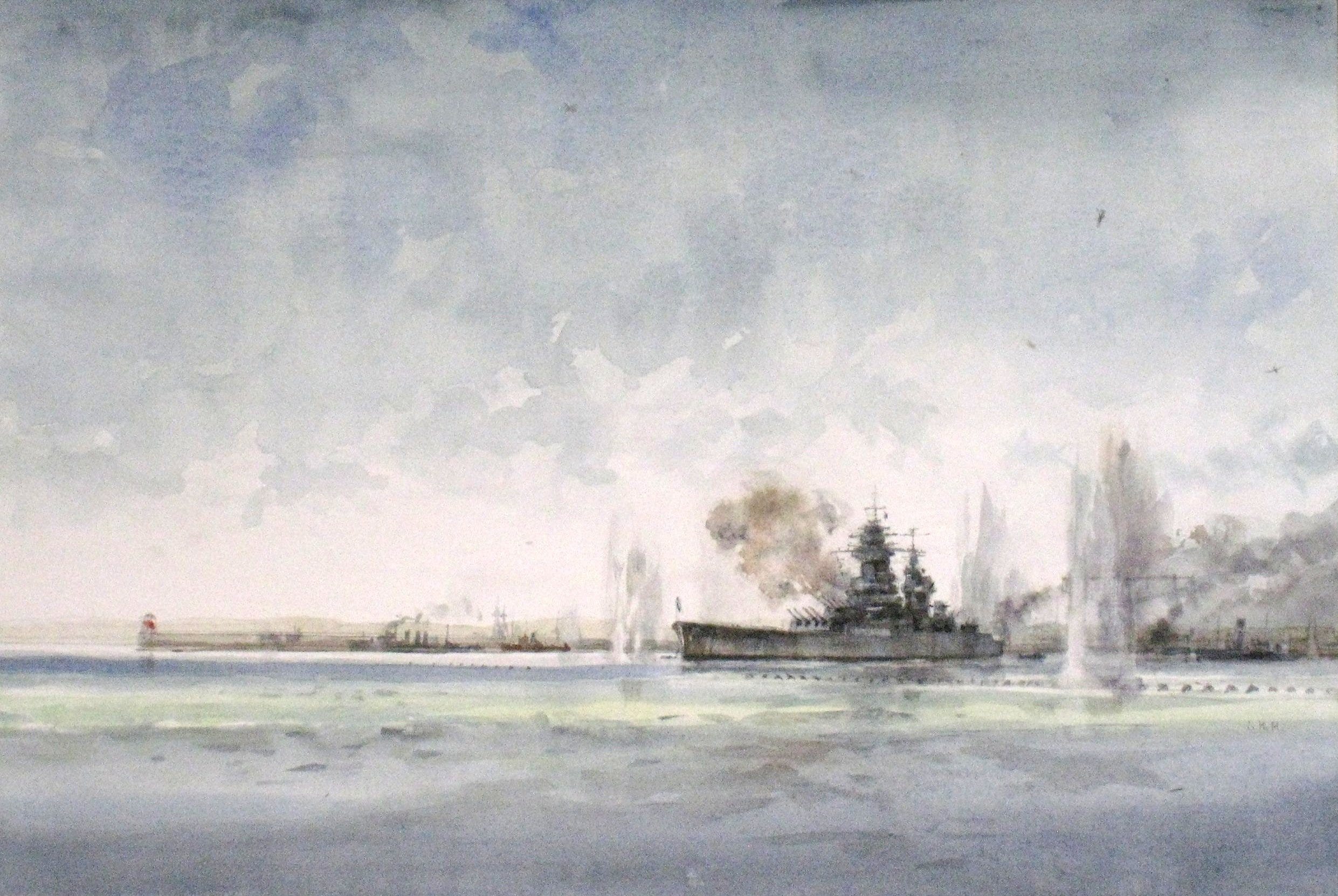
I co-edited this book, Planning for War at Sea: 400 Years of Great Power Competition, with Paul Kennedy. It’s a sequel to our previous edited volume, Navies in Multipolar Worlds: From the Age of Sail to the Present. Both grew out of conferences held at Yale, but this most recent volume is much prettier. The cover image is a painting by the late Ian Marshall of the French battleship Richelieu receiving fire from British ships at Dakar in 1941. We thought it nicely illustrated the book’s theme, which is that it is very difficult for navies to prepare for the next war. After all, in 1939, how many thought that just two years later, the British would be fighting Vichy French forces?
Here’s what Paul had to say about that in his introduction, which is entitled “The Best-Laid Plans”:
The original proposed title of the volume used some poetic license to borrow from the poet Robert Burns’ line about “the best-laid schemes [plans] . . . go oft awry.” That phrase seemed apt enough when we consider the subject of our symposium. In the long sweep of naval history, many admiralties and their planners have entered into war only to find that things were going awry: their strategic assumptions were flawed, there was “something wrong” with their ships (Admiral Beattie’s lament at Jutland), logistics were inadequate, intelligence was badly wrong, and political leaders were either too rash or too timid. Not all prewar naval preparations and plans went astray, of course, and it is at least as useful to reflect on those that were successful as it is to analyze the cases of where navies went badly wrong. There are cases here (the Royal Navy in 1914 and the U.S. Navy in 1941) where a leading naval power took heavy losses at the war’s beginning but enjoyed so many advantages that strategic recovery was possible; or of where neither side’s navy had prepared for the conflict (the First Anglo-Dutch War); or of where a nation’s best-laid plans were reasonably well established but swept away by larger circumstances (the French navy in 1940). We have also included, near the end of this collection, some probing essays that consider how well or poorly today’s three leading navies—the Russian, the Chinese, and the American—have configured themselves during the Cold War era and may be doing so in preparation for the challenges of future conflict.
Paul has never written a short declarative sentence in his life. I mean that as a compliment: his sentences cascade like a stream through the woods, each rock carefully placed to keep his reader in the riverbed.
Here’s a link to buy the book on the publisher’s website:
And finally, here’s the table of contents:
INTRODUCTION: THE BEST-LAID PLANS
Paul Kennedy
CHAPTER 1: THE FIRST ANGLO-DUTCH WAR, 1652–1654
How an Unexpected Enemy with Innovative Tactics Started an Arms Race with Long-Term Strategic Consequences
John B. Hattendorf
CHAPTER 2: WHAT TO EXPECT WHEN YOU’RE EXPECTING THE FRENCH REVOLUTION
Evan Wilson
CHAPTER 3: “A MAD ACTION”
The Almost-War between the United States and Morocco, 1801–1803
Abigail Mullen
CHAPTER 4: THEORY MEETS THE REALITY OF WAR
Julian S. Corbett, His Theories, and the First World War
Kevin D. McCranie
CHAPTER 5: CONTESTING THE GERMAN ISLAND CHAIN
Winston Churchill and the Search for a Naval Offensive during the First World War
John H. Maurer
CHAPTER 6: THE WARS YOU WANT VERSUS THE WARS YOU GET
The Limitations of the Interwar U.S. Navy as a Historical Model
Ryan Wadle
CHAPTER 7: JANUS AND MARS
French Naval and Defense Planning in the Interwar Years, 1922–1940
Martin S. Alexander
CHAPTER 8: ADMIRAL NAGANO OSAMI AND THE JAPANESE NAVY’S DECISION FOR WAR AGAINST THE UNITED STATES
Peter Mauch
CHAPTER 9: WHICH ADVERSARY, WHEN?
The Strategic Dilemmas of the Royal Navy, 1939–1945
Geoffrey Till
CHAPTER 10: FROM WATCHTOWER TO ICEBERG
Three Cases of Doctrinal Adaptation in the Pacific War, 1941–1945
John T. Kuehn
CHAPTER 11: THE MARITIME STRATEGY’S “MISSING MIDDLE”
Ryan Peeks
CHAPTER 12: DETERRENCE OR ESCALATION?
A Reappraisal of the 1980s Maritime Strategy
Sebastian Bruns
CHAPTER 13: BACK TO ITS COMFORT ZONE
The Russian Navy’s Views of Its Principal Adversaries, Strategy and Force Application, and Capability Development
Alexey D. Muraviev
CHAPTER 14: ADVERSARIES AND PLANNING ASSUMPTIONS
China’s Navy and the Post–Cold War World
Andrew S. Erickson
CHAPTER 15: NAVIES AND STRATEGIC SURPRISES
The Post–Cold War U.S. Navy
Norman Friedman
CONCLUSION
Paul Kennedy and Evan Wilson
I hope you agree that there’s something for everyone in there. In my next post, I’ll provide some excerpts from my chapter and maybe also from the conclusion.
Looks great, Evan! Congratulations! Hopefully I can get in Chile.