

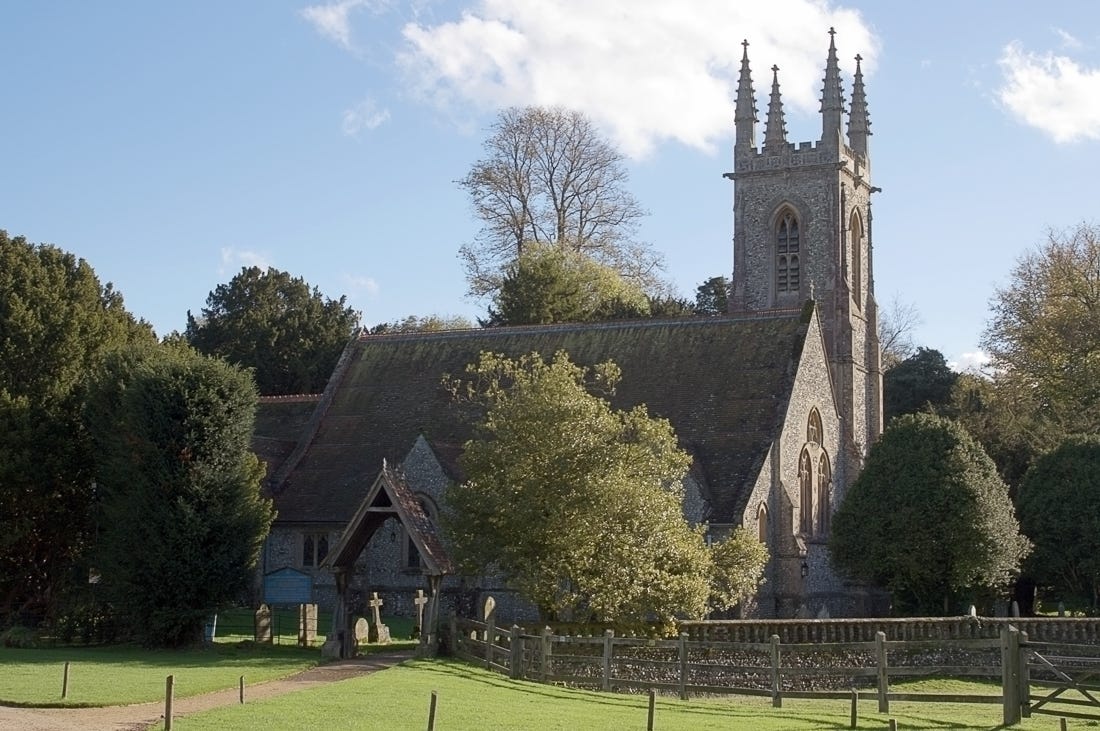
Chawton? It’s a village in Hampshire, near the road from London to Winchester, 25 miles north of Portsmouth, outfitting harbor for many of Jack Aubrey’s commands. In 1761 the Reverend George Austen, through the generosity of a second cousin married to a landowner, was given a position as rector of the church nearby in Stevenson. In addition to the duties of the parish, he and his wife, daughter of the master of Baliol College at Oxford, started a boys’ school in their new house.
The couple also was busy in another way, having what one relative called “the violently rapid increase of their family.” Three sons were born in the first three years, and after a short pause, four more children in subsequent years. When the youngest of those seven turned three, and her mother was thirty-nine, a sixth and last son, Charles, was born.
As an adult Charles was a captain in the British navy for three decades. Evan wrote about his career in an earlier post:

His older brother, Francis William, was more distinguished. He became Admiral of the Fleet, was knighted, and lived until he was 91.
These are the Austen children – James, George, Edward, Henry, Cassandra, Francis, Jane, and Charles. I travel to Chawton for the seventh. It’s the 250th anniversary of Jane Austen’s birth.
And this is a Substack about Patrick O’Brian?
I first started thinking of this pilgrimage halfway through Post Captain, both the first time my children Evan and Emily and I listened to Patrick Tull on Recorded Books and my subsequent two readings, pencil in hand, decades apart. Innumerable works of fiction spring from love triangles, and in O’Brian’s case he creates one with Sophia and Diana becoming enmeshed with Jack Aubrey (substitute whatever word you find appropriate for ‘enmeshed.’) O’Brian sweetens the complication by having Stephen fall in love with Diana, who is fascinated by Jack and considers using him but does not love him. Stephen is a different matter.
Six of Austen’s best-known novels are structured this way. Take the best-known novel, Pride and Prejudice, a cash machine for filmmakers (Google’s AI tells me there are 17 films or series since 1938 and three other related films, including Bollywood’s Bride and Prejudice and the 2016 Pride and Prejudice and Zombies). Elizabeth Bennet finds Fitzwilliam Darcy grossly prideful and has a strong prejudice for the dashing soldier, George Wickham, only to see herself (after Wickham attempts to seduce her younger sister) as the one with the obtuse angle.
There are other reasons I thought of Jane Austen. Sophia’s mother Mrs. Williams in Post Captain is surely descending from some mothers and aunts in Jane Austen. Consider Mrs. Bennet in Pride and Prejudice, Miss Bates in Emma, and to a lesser extent, Lady Bertram in Mansfield Park. Mrs. Williams joins them as a nonstop, both sycophantic and self-righteous, endlessly boring talker who makes everyone else’s business, especially any daughters’ relationship with a man, her own business.
So I am an unabashed lover of Jane Austen and Patrick O’Brian. After listening to Patrick Tull, I committed to listening to or reading all of O’Brian’s novels, and in honor of Miss Austen, I have reread her novels prior to this journey. I will report back next week with the results.
Your pilgrimage stirs memories of my own to Chawton -- and years of teaching and learning about the marriage plot. I'm eager to read your reflections.