

In the course of my various research projects, I occasionally find things in the archives that I don’t have space for in the final version of the project. Here is one such document: a plan for manning the Royal Navy, submitted to the Chancellor of the Exchequer and the First Lord of the Admiralty by a shipowner named Charles Lyall in 1813. Here’s how it begins:
Being convinced that the situation of this country, demands the utmost exertion of every Individual to give effort to the measures so wisely adopted by the present administration, I trust the importance of the subject about to be submitted to your consideration, will plead an excuse, for the liberty I have presumed to take by laying before you a plan, for Manning the Royal Navy without having recourse to the very distressing custom of Impressing Sailors for that purpose.
A “fun” game I like to play with prose like this is to see how few words I can use to say exactly what Lyall says:
There’s a war on; here’s a plan to eliminate impressment.
Now you try.
This ‘stack remains enthusiastic about all things Patrick O’Brian, so I should state that Jack Aubrey would have agreed with Lyall that impressment was a “very distressing custom.” Of course, Aubrey would also have pointed out that there was a war on, and so sometimes the needs of the service had to come before individual liberties. Moreover, impressment was tradition, and Aubrey would have been very hesitant to upset a naval customary practice, no matter how distressing.
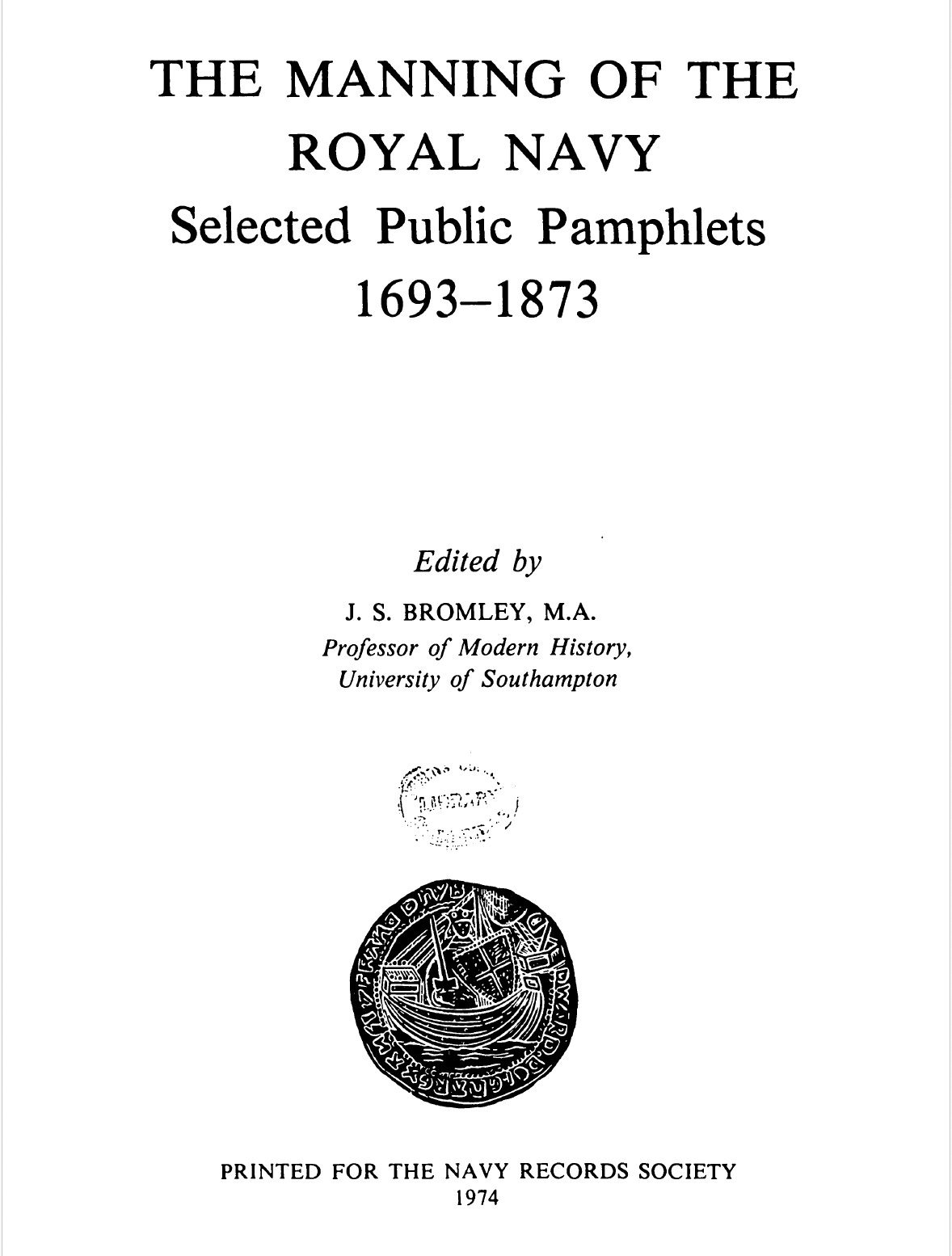
Documents like Lyall’s proposal were so common in the age of sail that the Navy Records Society published an entire 476-page volume of them in 1974 (though the one I’m discussing here is not included). Members of the public and naval officers regularly drew up plans that they argued would be superior to the Navy’s current manning system, which everyone agreed was fundamentally flawed.
Here’s how the British navy manned its ships. The navy recruited volunteers by paying bounties for skilled men, emphasizing patriotic service, and promising them prize money. In wartime, the navy supplemented its volunteers by impressing (or conscripting) men who “used the sea,” a deliberately vague phrase. Naval captains could impress men directly and did so frequently overseas, but in Britain from the middle of the eighteenth century, the navy centralized its impressment efforts in the Impress Service, which stationed captains in major ports to coordinate both recruiting and impressment efforts.
Again, the consensus was that the system was flawed, but why that was the case depended on the observer.
Naval officers looked jealously at France and Spain, which had large centralized rotating conscription services that often provided more men at the beginning of a war than the British system.
Merchants wanted their skilled sailors protected from impressment; failing that, they wanted a more predictable way to interact with the navy’s manning needs.
A sizable portion of the political world called attention to the system’s unfairness and the hypocrisy of “the liberty of the subject” as a political slogan.
Sailors had mixed feelings, ranging from accepting impressment as a fact of life at sea to outright violent resistance. Port towns tended to be the most resistant, as it was on them that the burden of having men forcibly removed for years at a time fell.
The bottom line is that there were a multitude of perspectives on why impressment was bad, and consequently a multitude of ideas for fixing it—which brings us back to Lyall’s proposal to the Admiralty in 1813. He approached the problem from the perspective of a shipowner sick of losing his crews to the Navy. He promised that his system would generate “in a very short time” twenty to thirty thousand ordinary sailors (not as skilled as able seamen but not unfamiliar with the sea, either).
For context, in 1813, the Navy had more than 140,000 men at sea, its largest-ever size in the age of sail. If Lyall’s plan worked, therefore, it was worth taking seriously. When I read this the first time in the archives, I thought: ok, let’s see what he’s got!
Well, uh, hmmm:
Draft “an average” of three 14-year-old boys from each parish poorhouse in Britain. He estimated there were about 15,500 parishes in Britain and Ireland.
The navy would train the boys into sailors. The navy would also provide clothing (deducted from the boys’ wages of course) and the government would fine any parish that refused to give up its boys.
If you did this every year, you would generate a steady supply of boys who would turn into sailors because “it being a well-known fact that none but those who go to sea when lads ever become good sailors.”
Lyall admits in a marginal note that the ethics of his proposal leave something to be desired. He says maybe the boys’ parents could get a bounty of £2, but in any case, most of them would be orphans.
There’s a real Hunger Games vibe here, with orphan boys as tributes!
The copy of the proposal that I read was in the Treasury archives (TNA, T 48/83), and it’s clear that Lyall understood his audience: “Should this plan be thought worthy of being adopted a great saving might be made in the Impress Service, as well as nearly all the Bounty that is now given, for most of the Sailors when Impressed, do afterwards by Entering (as it is called) take it.” In other words, Lyall claims that most of the pressed men in the navy were getting bounties that were supposed to be reserved for volunteers.1 If you no longer paid bounties to pressed sailors, you would save money—up to £200,000 per year, thought Lyall.
The bottom line, Lyall argues, is that even this draconian system “would be nothing compared to the infringement on the liberty of the subject by the custom of Impressing.” It would no longer be necessary to press men returning from long voyages, “men who after an absence of 18 or 20 months from their wives and families anxious to return to them. … Humanity alone would dictate to us, to adopt such a plan if possible.”
I don’t think he has that ethical calculation quite right, but nevertheless I thought the document was interesting. So too, apparently, did the Chancellor of the Exchequer and the First Lord of the Admiralty, who met with Lyall about it. How seriously they took it, I don’t know, but in any case, peace in 1815 removed the need to do any more with it.
This is a very controversial point in the academic literature on impressment. Lyall provides no evidence other than hearsay for his assertion, so his pamphlet won’t sway anyone on either side of the debate. If you want to wade into the controversy, here are some of the key readings I assign to my class on the subject:
Denver Brunsman, The Evil Necessity: British Naval Impressment in the Eighteenth-Century Atlantic World (University of Virginia Press, 2013).
J. Ross Dancy, The Myth of the Press Gang: Volunteers, Impressment and the Naval Manpower Problem in the Late Eighteenth Century (The Boydell Press, 2015).
Nicholas Rogers, “British Impressment and Its Discontents,” The International Journal of Maritime History 30, no. 1 (2018): 52–73.
J. Ross Dancy, “Sources and Methods in the British Impressment Debate,” The International Journal of Maritime History 30, no. 4 (2018): 733–46.
James Davey, Tempest: The Royal Navy and the Age of Revolutions (Yale University Press, 2023).