

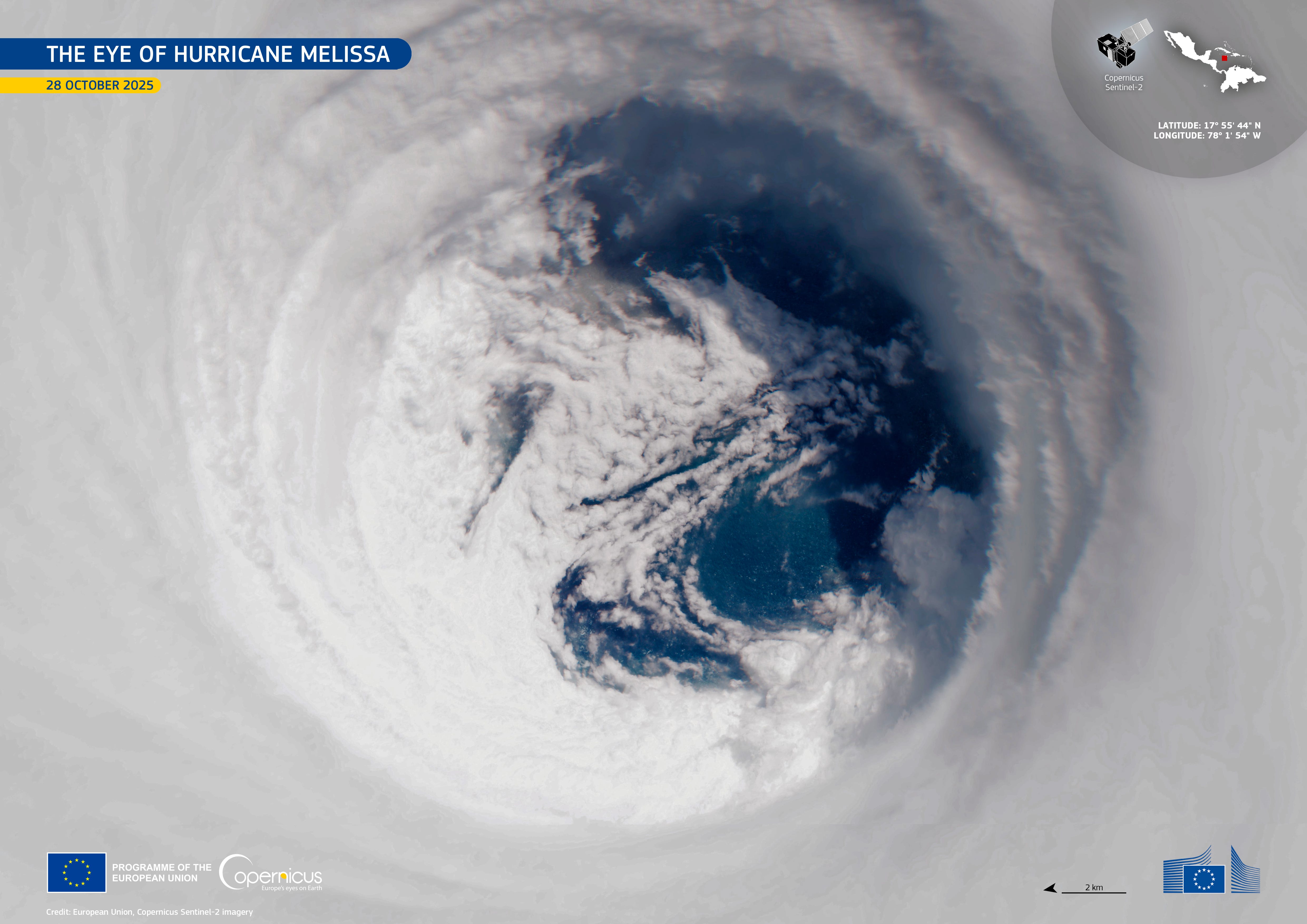
I read with horror and awe the news coverage of Hurricane Melissa’s landfall in Jamaica last week. Few natural phenomena are as beautiful as a hurricane; none is as destructive. Here was the eye:
And from space:
And here’s how to help people.
What does this have to do with the naval history of the age of sail, I can hear you asking, quite reasonably. Well, as Melissa made landfall, I happened to be revising the chapter in my biography that covers a different hurricane that hit Jamaica, in 1751. The subject of my biography, John Jervis, was a midshipman on HMS Gloucester, the British flagship on the station. The goal of the passage below, which comes at the beginning of a chapter, was to describe what it might have been like for Jervis during the hurricane. I used the ship’s log to get a sense of the timing and the severity of the storm:
As the hurricane approached Gloucester’s anchorage, Jervis helped the crew strike the topmasts to the deck. Before they could, Townshend’s pennant blew away. The log upgraded the storm from “fresh gale” to “violent hard squalls with rain.” There was no way out, and nothing to be done except to endure. For those below decks, what stood out most was the sound. The hurricane-force winds reached a pitch that sailors did not normally hear. Everyone listened intently for signs of catastrophic damage while trying to wedge themselves into a position that kept them from being tossed around like beans inside a maraca. The worst moment was when the ship’s long boat tore loose and went overboard—was that the beginning of a serious break-up? On deck, air was water and water was air, all of it moving at astonishing speeds. The midshipmen watched Townshend who watched the rigging, the sea state, and most importantly the anchor cables. If they parted, Gloucester would be at the mercy of the wind and water and likely thrown ashore.
Gloucester was the biggest ship in the harbor, and over the course of twelve hours, she rode out the storm, though many smaller vessels were not as lucky. The Gloucester’s crew picked up four men whose sloop had capsized near them. Ferret lost all her masts, as did several other ships. It was the worst storm to hit Jamaica in decades. We do not know how many people died, but one frigate, three snows, two brigantines, seven schooners, and fifteen sloops were listed as total losses afterwards. One account recorded that ashore, “several Negroes, Cattle &c.” were killed, and the wharves were blown away. A copy of that printed account survives in St. Vincent’s papers, suggesting that he kept it as a memento. It was understandably a harrowing and formative experience for him.
This exercise made it clear to me that a picture really is worth a thousand words (and a video from a hurricane is worth even more), but such is the nature of historical writing that we have to make do with adjectives and imagination.
Here’s the memento I mentioned:
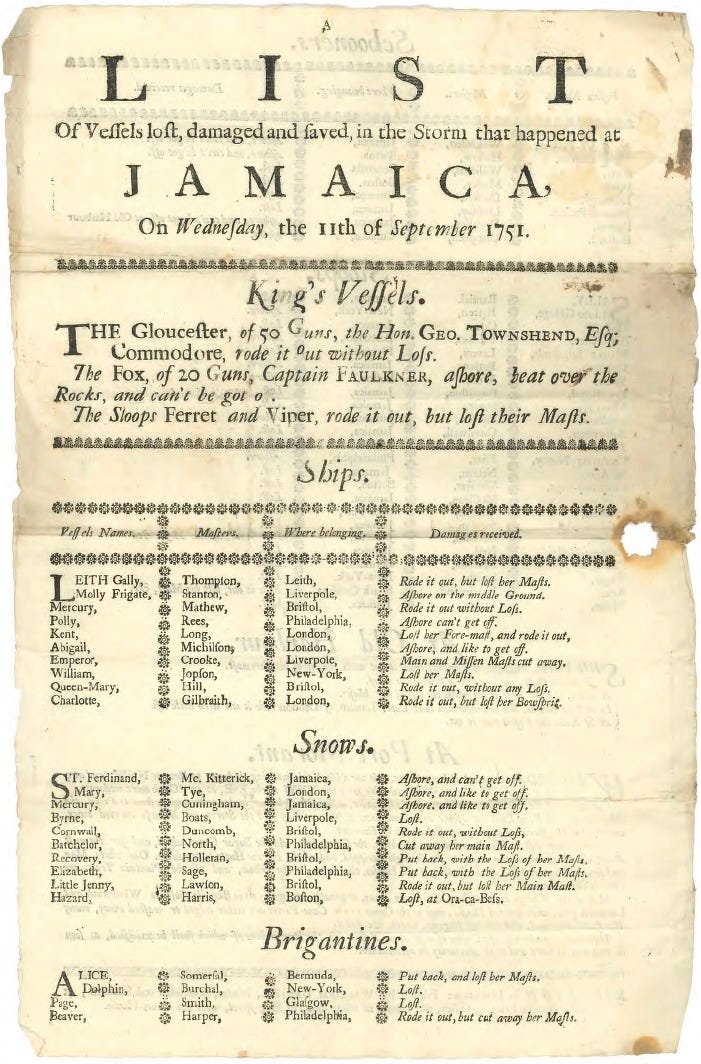
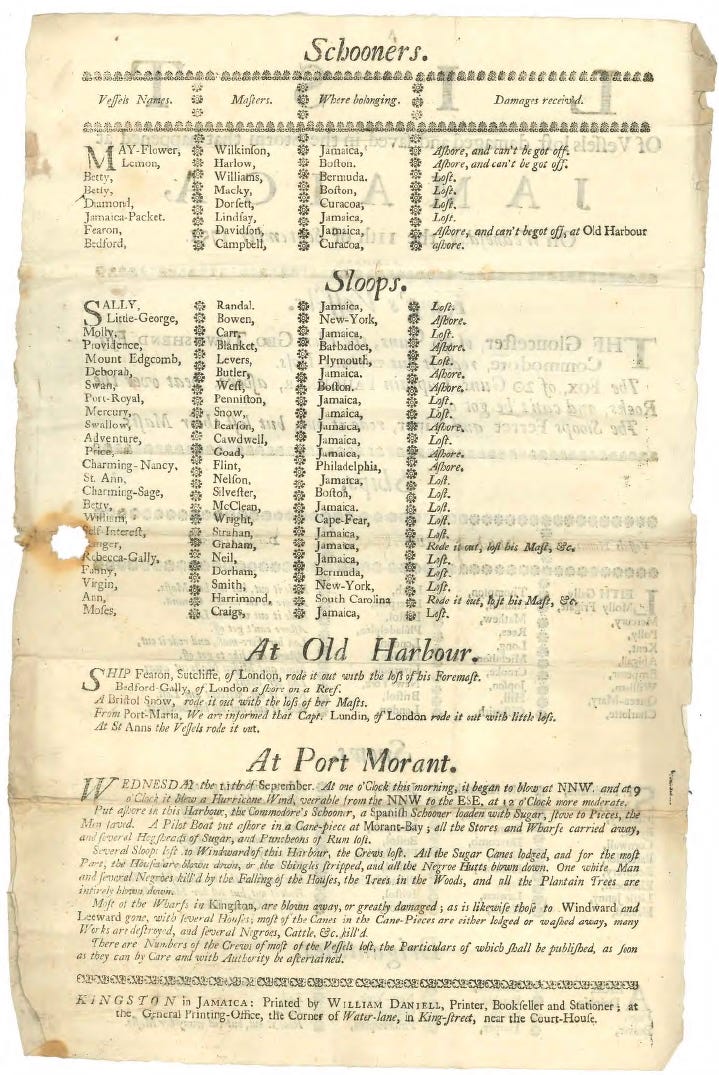
There are no notes attached to the memento, and it appears in Jervis’s files at the Staffordshire Record Office alongside other miscellaneous naval documents like the navy list. I am inferring from the document’s survival that the hurricane it describes lingered for a long time in Jervis’s memory—he doesn’t mention it specifically in any of his surviving correspondence.
Such are the limits of biography specifically and historical research generally: we infer, we imagine, and we describe, but there always comes a point at which we cannot really know.
